Supplied as capsules or tablets
Metabolic & Weight
At a glance
Ten answers, each one line. Open any row for the detail behind it.
What it does Included because it may make injectable peptides obsolete for most people.
Included because it may make injectable peptides obsolete for most people. It is a small molecule, not a peptide, so it survives digestion without the absorption enhancers and strict fasting rules that oral semaglutide requires.
Half-life ~25–35 hours after a single oral dose, rising to ~48–68 hours… — Documented
~25–35 hours after a single oral dose, rising to ~48–68 hours at steady state (phase 1).
Typical studied dose No established dose. Each trial protocol fixes its own and publishes it… — Depends on the study
No established dose. Each trial protocol fixes its own and publishes it in the registry entry, under medical supervision that is part of the dose. There is no approved amount for use outside a study.
How often it is used Whatever the protocol specifies. The registry entry for a given study… — Depends on the study
Whatever the protocol specifies. The registry entry for a given study states its interval; nothing establishes one outside a study.
How it is taken Oral, once daily — Documented
Oral, once daily
Main side effects Not approved at the time of this review · Class contraindications still apply · GI adverse effects persist — Carries serious risk
Not approved at the time of this review — Regulatory decisions were pending; nothing here should be read as an approval.
Class contraindications still apply — Thyroid C-cell and pancreatitis cautions are receptor-driven, not formulation-driven.
GI adverse effects persist — Nausea, vomiting and diarrhea occur at rates comparable to injectable GLP-1 agonists — the route changed, the receptor did not.
Storage before mixing Kept dry, sealed and at room temperature unless the label says…
Kept dry, sealed and at room temperature unless the label says otherwise. Moisture is what shortens the life of a capsule or tablet.
Shelf life after mixing Nothing to mix — it is not supplied as a powder. The relevant date is…
Nothing to mix — it is not supplied as a powder. The relevant date is the one printed on the product.
Evidence level 4/5 · Strong — Documented
Consistent human randomized trials, or approval outside the United States.
Regulatory status In Clinical Trials — Depends on the study
Not a peptide. Phase 3 (ATTAIN and ACHIEVE programs). Not approved at the time of review. Investigational at the time of review. Check current FDA status before relying on this page.
Overview
Included because it may make injectable peptides obsolete for most people. It is a small molecule, not a peptide, so it survives digestion without the absorption enhancers and strict fasting rules that oral semaglutide requires.
Investigational — not approvedInvestigational at the time of review. Check current FDA status before relying on this page.
| Regulatory status | Not a peptide. Phase 3 (ATTAIN and ACHIEVE programs). Not approved at the time of review. |
|---|---|
| Drug class | Non-peptide small-molecule GLP-1 receptor agonist — orally bioavailable |
| Route | Oral, once daily |
| Half-life | ~25–35 hours after a single oral dose, rising to ~48–68 hours at steady state (phase 1). |
| Evidence rating |
4/5 Strong
Evidence rating 4 out of 5: Strong
Consistent human randomized trials, or approval outside the United States. |
| Studied in | Phase 3 ATTAIN trials in obesity and ACHIEVE trials in type 2 diabetes; multiple phase 2 trials preceding them. |
Orforglipron sequence & structure
Orforglipron is not a peptide. It has no amino-acid sequence; its formula and molecular weight (882.97 Da) are given for reference.
| Molecular formula | C48H48F2N10O5 |
|---|---|
| Molecular weight | 882.97 Da (average, free base) |
| SMILES | C[C@H]1C[C@]1(C2=NOC(=O)N2)N3C4=C(C=C(C=C4)[C@H]5CCOC(C5)(C)C)C=C3C(=O)N6CCC7=NN(C(=C7[C@@H]6C)N8C=CN(C8=O)C9=C(C1=C(C=C9)N(N=C1)C)F)C1=CC(=C(C(=C1)C)F)C |
| Identifiers | CAS 2212020-52-3 · PubChem CID 137319706 · DrugBank DB18964 |
| Which molecule | Record describes the free base orforglipron (CAS 2212020-52-3, UNII 7ZW40D021M, PubChem CID 137319706), which is what the pepteyes monograph (LY3502970, the investigational oral GLP-1 agonist) refers to. The marketed tablet (Foundayo, Eli Lilly) contains orforglipron calcium: the FDA label writes it per drug unit as C48H47F2N10O5·0.5Ca, MW 902.0 (CAS 2415797-61-2); PubChem CID 167713250 lists the same salt as the full 2:1 species calcium bis(orforglipronate), C96H94CaF4N20O10, MW 1804.0. |
| Sources | FDA Global Substance Registration System (precision.fda.gov), UNII 7ZW40D021M: INN/USAN orforglipron, formula C48H48F2N10O5, CAS 2212020-52-3, InChIKey, LY-3502970PubChem CID 137319706 (PUG REST: formula, MW 883.0, isomeric SMILES, InChIKey, IUPAC name, monoisotopic mass 882.3777)ChEMBL CHEMBL4446782 API (pref_name ORFORGLIPRON, small molecule, formula C48H48F2N10O5, MW 882.97, InChIKey; INN/USAN synonyms)DailyMed: FOUNDAYO (orforglipron) tablets prescribing information, rev. July 2026, section 11 Description (orforglipron calcium, C48H47F2N10O5·0.5Ca, MW 902.0)Wikipedia: Orforglipron (cross-check of CAS, PubChem, DrugBank, ChEMBL and UNII identifiers, molar mass 882.974, Chugai origin, US approval April 2026) |
Not a peptide: orforglipron (LY3502970, discovered by Chugai and licensed to Lilly in 2018) is an orally bioavailable non-peptide GLP-1 receptor agonist, so there is no sequence, terminus or residue modification to report; UNII 7ZW40D021M, InChIKey USUWIEBBBWHKNI-KHIFEHGGSA-N, monoisotopic mass 882.3777. FDA GSRS, PubChem, ChEMBL and the FDA label agree on the free-base formula C48H48F2N10O5 (MW 882.97-883.0); the label's 902.0 figure is for the hemi-calcium salt. Regulatory status: the pepteyes monograph still says 'trials', but FDA approved it as Foundayo in April 2026 for chronic weight management in adults (label revised July 2026); type 2 diabetes remains investigational, and ChEMBL's 'max phase 3' entry is stale.
Record confidence: high — two independent authoritative sources agree on the sequence and modifications. Every sequence on the site is listed with its sources on the peptide sequences index.
How it works
Binds the GLP-1 receptor at a site accessible to a small molecule, producing incretin signalling without a peptide backbone. Because it is not degraded by gut proteases, it needs no permeation enhancer and has no food or water restrictions.
Evidence base
Rated 4 of 5 — Strong. Consistent human randomized trials, or approval outside the United States.
- Large phase 3 program with active and placebo comparators.
- Regulatory status is the fastest-moving fact on this page.
Benefits and risks, weighed against the evidence
Every entry below carries the strength of the evidence behind it — three bars for strong human data, two for moderate, one for preliminary or preclinical work. The two columns are not equal by design: where a compound has more documented risk than demonstrated benefit, the lists say so.
Reported benefits
4 entries · 3 on strong human evidence
-
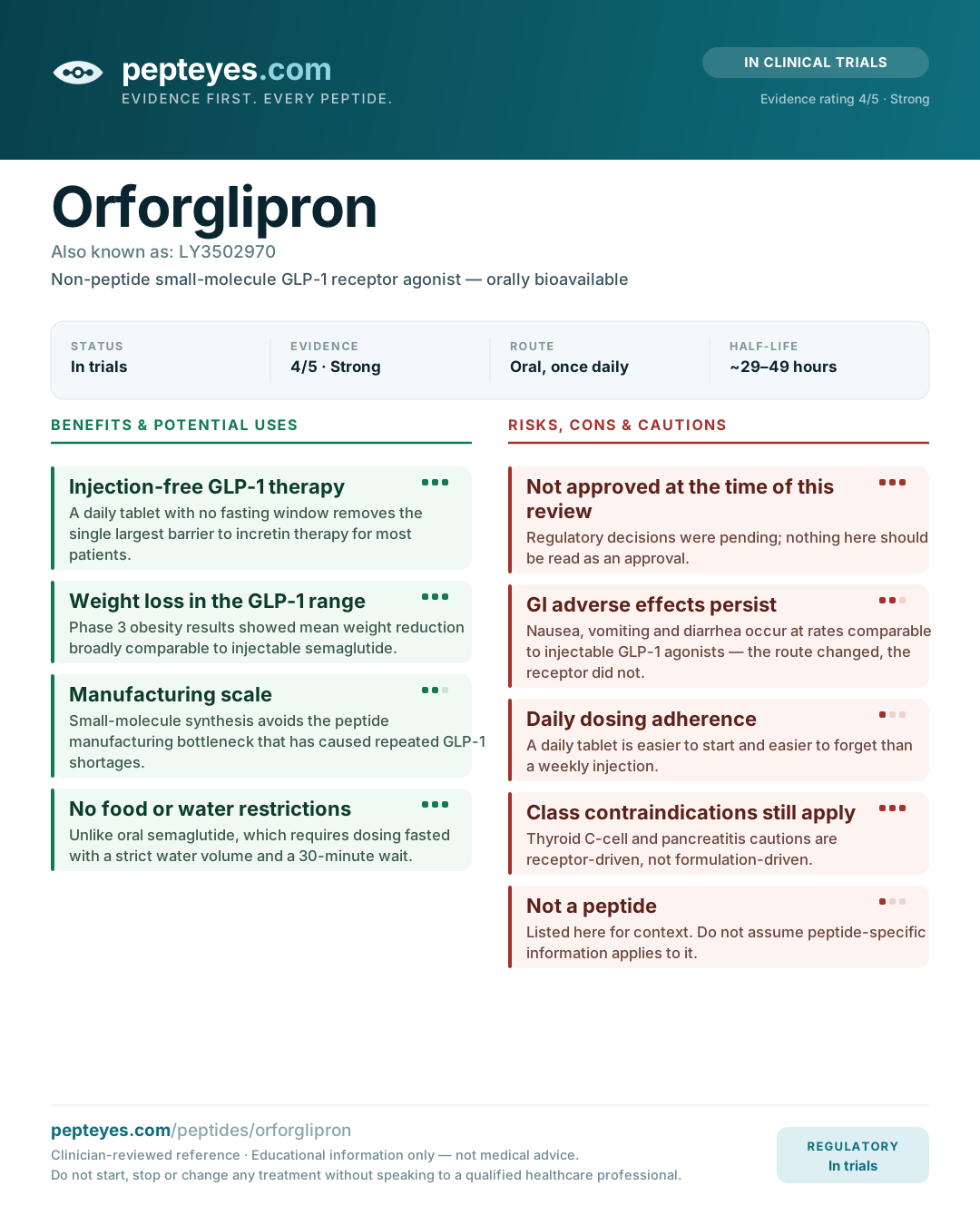
Injection-free GLP-1 therapy
A daily tablet with no fasting window removes the single largest barrier to incretin therapy for most patients.
Evidence: Strong evidence -
Weight loss in the GLP-1 range
Phase 3 obesity results showed mean weight reduction broadly comparable to injectable semaglutide.
Evidence: Strong evidence -
Manufacturing scale
Small-molecule synthesis avoids the peptide manufacturing bottleneck that has caused repeated GLP-1 shortages.
Evidence: Moderate evidence -
No food or water restrictions
Unlike oral semaglutide, which requires dosing fasted with a strict water volume and a 30-minute wait.
Evidence: Strong evidence
Risks and cautions
5 entries · 2 serious or common
-
Not approved at the time of this review
Regulatory decisions were pending; nothing here should be read as an approval.
Evidence: Serious -
GI adverse effects persist
Nausea, vomiting and diarrhea occur at rates comparable to injectable GLP-1 agonists — the route changed, the receptor did not.
Evidence: Moderate evidence -
Daily dosing adherence
A daily tablet is easier to start and easier to forget than a weekly injection.
Evidence: Minor -
Class contraindications still apply
Thyroid C-cell and pancreatitis cautions are receptor-driven, not formulation-driven.
Evidence: Serious -
Not a peptide
Listed here for context. Do not assume peptide-specific information applies to it.
Evidence: Minor
Counts are not a score. A single serious risk can outweigh several well-supported benefits, and a long benefit list built on preclinical work outweighs nothing at all.
Opinion — what people actually report
4 themes · 2 reported benefits · 1 reported problem
This is the weakest tier on this site. These are themes drawn from public discussion — forums, subreddits and patient threads — not from trials. There is no control group, no denominator, and no way to confirm that what someone injected matched its label. People post when a result is dramatic and when something goes wrong, and rarely when nothing happens, so treat everything below as a description of the conversation rather than of the compound. The bars count how often a thing is said, not how well it is supported.
-
Excitement is entirely about it being a pill Reported benefit. Dominant theme: Comes up in most discussions of this compound.
The dominant theme by far. Needle avoidance, no cold chain and no reconstitution are what people talk about, ahead of efficacy.
-
Almost no first-hand accounts Practical note. Dominant theme: Comes up in most discussions of this compound.
Discussion is speculation about trial results and availability, not experience.
-
No food or water restrictions, unlike oral semaglutide Reported benefit. Recurring: Raised regularly, though not by everyone.
A frequently noted practical advantage, since the peptide-based oral drug requires fasting and careful timing.
-
GI effects still expected Reported problem. Recurring: Raised regularly, though not by everyone.
Trial data showing nausea and vomiting are widely discussed, tempering the enthusiasm.
Where the reports and the evidence part ways
The community is discussing this drug reasonably accurately, mostly because there is little experience to distort — it is a non-peptide small molecule, which is exactly why it avoids the absorption problems of oral semaglutide. The one thing worth flagging is a category error that appears constantly: this is not a peptide, and it is included on this site precisely because it is routinely discussed as though it were. Its regulatory status and its phase 3 readouts are also moving faster than forum summaries of them.
Readers on Orforglipron
Questions and answers from readers, under generated names. Nothing here has been checked or reviewed by the site and none of it is medical advice. It is the least verified thing on this page — and it is here because people ask each other these things anyway, and most of the other places they can ask are run by sellers.
0 questions · 0 answers
No questions yet. Ask the first one above — it takes one box and an email address.
How names work, and the house rules
Names. Every verified address is given one generated name — two ordinary words — and keeps it. Nobody chooses a name and nobody can take another's. Posts marked desk were written by the site's own editorial desk, usually to open a thread; they carry a generated name like everyone else's and are held to the site's rules, which means they never state an amount.
What is not allowed. Selling, sourcing, vendor names, coupon codes and "message me" — posts that read that way are held and usually removed. Personal medical details you would not want public. Abuse. Instructions framed as what someone else should do.
What this is not. A reader's report of what happened to them is a report, not a finding, and an answer here is one person's view. Nothing in this section changes the evidence rating above it. If something you read here would change what you take, take it to a pharmacist or physician first.
Your data. Delete any post of yours at any time, or remove everything you have written together with your name. Details in the privacy notice.
Who should avoid it
- Medullary thyroid carcinoma or MEN2 history
- Pregnancy
- Prior pancreatitis (relative)
If used under medical supervision, monitor
- HbA1c, weight
- GI tolerability during titration
Interactions
Not exhaustive. Always have a pharmacist or physician review your full medication list — including supplements.
- Insulin and sulfonylureas — hypoglycemia risk
- Fewer absorption interactions than oral semaglutide, since it needs no permeation enhancer
Regulatory & legal status
Investigational at the time of review. Check current FDA status before relying on this page.
Infographic
Where to read further
We link to live literature searches rather than a frozen citation list, so you always see current results — including anything published after our last review.
- PubMed — all published literature on Orforglipron
- PubMed — randomized controlled trials only
- ClinicalTrials.gov — registered human trials
Related peptides in Metabolic & Weight
Terms used on this page
- Permeation Enhancer
- A permeation enhancer is an excipient that transiently increases how readily a mucosal barrier admits a co-formulated drug, making otherwise negligible absorption of peptides commercially useful.
- Peptide Backbone
- The peptide backbone is the repeating nitrogen, alpha-carbon and carbonyl-carbon chain shared by every peptide, and its limited rotational freedom determines which shapes the molecule can adopt.
- The Incretin Effect
- The incretin effect is the larger insulin response to oral glucose than to intravenous glucose matched for the same blood glucose profile, and it is mediated mainly by GLP-1 and GIP.
- Glucagon-Like Peptide-1 (GLP-1)
- Glucagon-like peptide-1 is an incretin hormone released by intestinal L-cells after a meal that stimulates glucose-dependent insulin secretion and suppresses appetite.
- Phase 3 Trial
- A Phase 3 trial is the large confirmatory study, powered for a prespecified clinical endpoint, on which a marketing application and the resulting product label are built.
- Placebo and Placebo Control
- A placebo is an inactive intervention matched to the real one in appearance and route, used as a control arm so that improvement caused by the drug can be separated from improvement that would occur anyway.
This page is educational information, not medical advice. It cannot account for your medical history, medications, or risk factors. Do not start, stop or change any treatment based on it. Speak to a qualified healthcare professional who knows your case.