Supplied ready in solution
Hormonal & Reproductive
At a glance
Ten answers, each one line. Open any row for the detail behind it.
What it does The definitive demonstration that dosing pattern determines direction.
The definitive demonstration that dosing pattern determines direction. Leuprolide is a more potent GnRH agonist than the natural hormone — and because it is given continuously rather than in pulses, it shuts the reproductive axis down instead of switching it on.
Half-life ~3 hours (depot formulations release over months) — Documented
~3 hours (depot formulations release over months)
Typical studied dose Set on the approved label, which states the starting dose, how it is… — On the label
Set on the approved label, which states the starting dose, how it is increased and the maximum. Read it there rather than anywhere else — including here.
How often it is used The label schedule is monthly. Dosing intervals follow the half-life… — On the label
The label schedule is monthly. Dosing intervals follow the half-life above, and the prescribing information is what sets them.
How it is taken Subcutaneous or intramuscular depot (monthly to 6-monthly) — Documented
Subcutaneous or intramuscular depot (monthly to 6-monthly)
Main side effects Testosterone flare in the first two weeks · Bone mineral density loss · Cardiometabolic effects — Carries serious risk
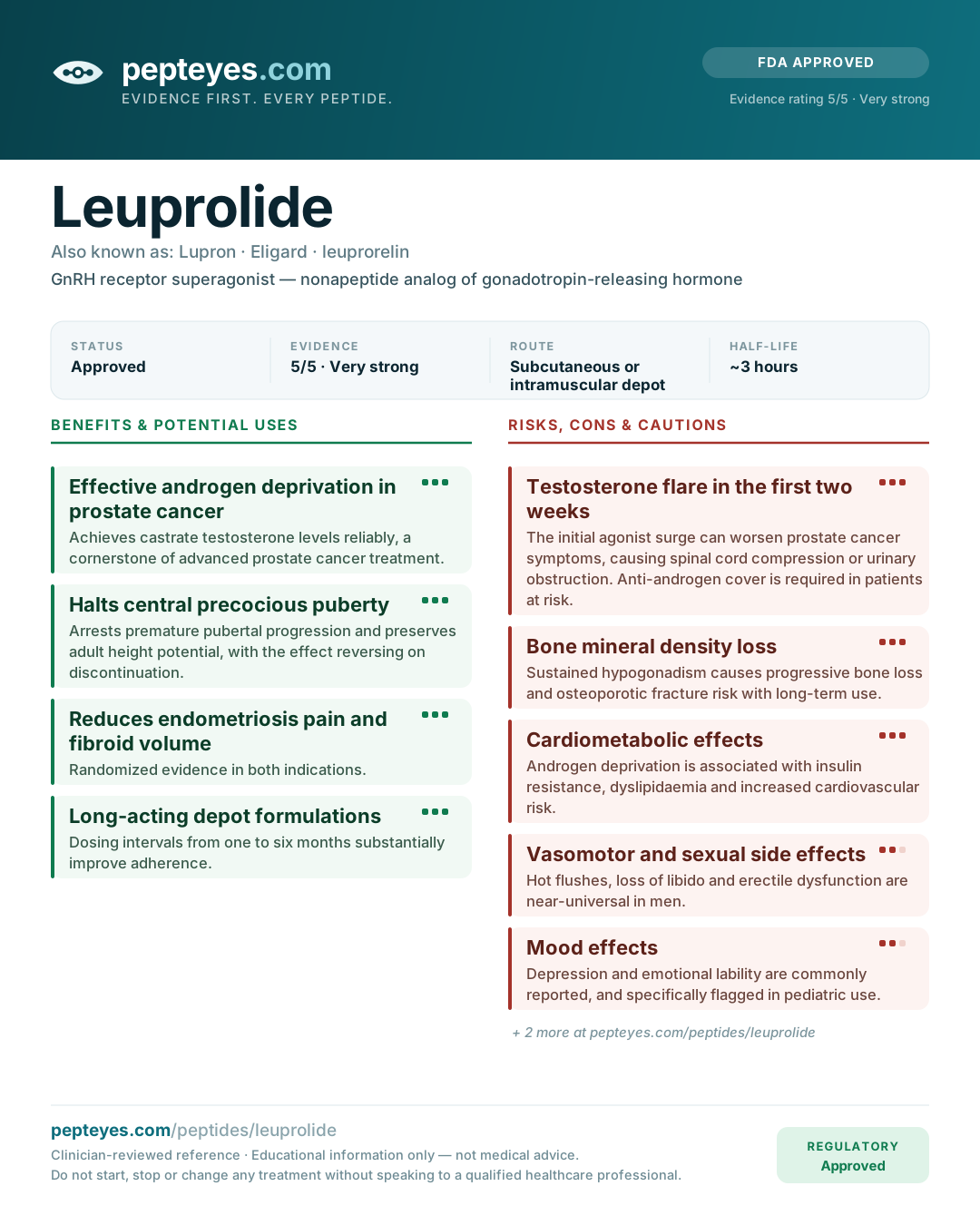
Testosterone flare in the first two weeks — The initial agonist surge can worsen prostate cancer symptoms, causing spinal cord compression or urinary obstruction. Anti-androgen cover is required in patients at risk.
Bone mineral density loss — Sustained hypogonadism causes progressive bone loss and osteoporotic fracture risk with long-term use.
Cardiometabolic effects — Androgen deprivation is associated with insulin resistance, dyslipidaemia and increased cardiovascular risk.
Storage before mixing Supplied already in solution and kept refrigerated, not frozen. Freezing…
Supplied already in solution and kept refrigerated, not frozen. Freezing a protein solution can aggregate it, which is not always visible.
Shelf life after mixing Nothing to mix — it is not supplied as a powder. The relevant date is…
Nothing to mix — it is not supplied as a powder. The relevant date is the one printed on the product.
Evidence level 5/5 · Very strong — Documented
Multiple phase 3 randomized trials plus regulatory approval in a major market.
Regulatory status FDA Approved — Documented
FDA-approved for advanced prostate cancer, endometriosis, uterine fibroids and central precocious puberty. Prescription drug.
Overview
The definitive demonstration that dosing pattern determines direction. Leuprolide is a more potent GnRH agonist than the natural hormone — and because it is given continuously rather than in pulses, it shuts the reproductive axis down instead of switching it on.
FDA ApprovedFDA-approved for advanced prostate cancer, endometriosis, uterine fibroids and central precocious puberty.
| Regulatory status | FDA-approved for advanced prostate cancer, endometriosis, uterine fibroids and central precocious puberty. |
|---|---|
| Drug class | GnRH receptor superagonist — nonapeptide analog of gonadotropin-releasing hormone |
| Route | Subcutaneous or intramuscular depot (monthly to 6-monthly) |
| Half-life | ~3 hours (depot formulations release over months) |
| Evidence rating |
5/5 Very strong
Evidence rating 5 out of 5: Very strong
Multiple phase 3 randomized trials plus regulatory approval in a major market. |
| Studied in | Decades of randomized trials in prostate cancer, endometriosis, uterine fibroids and central precocious puberty. |
Leuprolide sequence & structure
Leuprolide is a 9-residue linear peptide with a free C-terminal acid, carrying D-amino acid substitutions; molecular weight 1,209.42 Da.
lowercase = D-amino acid[bracketed] = non-standard residue
| Three-letter | pGlu-His-Trp-Ser-Tyr-D-Leu-Leu-Arg-Pro-NHEt |
|---|---|
| Length | 9 amino acid residues |
| Modifications |
|
| Molecular formula | C59H84N16O12 |
| Molecular weight | 1,209.42 Da (average, free base) |
| SMILES | CCNC(=O)[C@@H]1CCCN1C(=O)[C@H](CCCNC(=N)N)NC(=O)[C@H](CC(C)C)NC(=O)[C@@H](CC(C)C)NC(=O)[C@H](Cc1ccc(O)cc1)NC(=O)[C@H](CO)NC(=O)[C@H](Cc1c[nH]c2ccccc12)NC(=O)[C@H](Cc1c[nH]cn1)NC(=O)[C@@H]1CCC(=O)N1 |
| Identifiers | CAS 53714-56-0 · PubChem CID 657181 · DrugBank DB00007 |
| Which molecule | Leuprolide (USAN) and leuprorelin (INN) are the same molecule; Lupron, Lupron Depot, Eligard and Enantone are formulations of leuprolide acetate. This record describes the free-base nonapeptide. |
| Sources | ChEBI CHEBI:6427 (leuprolide: sequence, formula, MW, CAS)PubChem CID 657181 (formula, MW, IUPAC name, SMILES)KEGG DRUG D08113 (leuprorelin: formula, MW, CAS)Wikidata Q907160 (DrugBank, CAS, PubChem, ChEBI, ChEMBL cross-references) |
Formula, MW and CAS 53714-56-0 refer to the free base; marketed products are the acetate salt, which has a different CAS and MW. Position numbering follows GnRH (pGlu1 ... Pro9), so leuprolide is a [D-Leu6, Pro9-NHEt] GnRH analogue with the native Gly10 amide deleted; the ethylamide is written as cTerm other/-NHEt rather than -NH2 because it is a secondary amide.
Record confidence: high — two independent authoritative sources agree on the sequence and modifications. Every sequence on the site is listed with its sources on the peptide sequences index.
How it works
Continuous GnRH receptor occupancy causes receptor downregulation and pituitary desensitisation after an initial surge. LH and FSH fall, and gonadal steroid production drops to castrate levels within 2–4 weeks. Pulsatile GnRH, by contrast, stimulates the axis — which is why gonadorelin and leuprolide have opposite clinical effects.
Evidence base
Rated 5 of 5 — Very strong. Multiple phase 3 randomized trials plus regulatory approval in a major market.
- Decades of randomized trials across four distinct approved indications.
Benefits and risks, weighed against the evidence
Every entry below carries the strength of the evidence behind it — three bars for strong human data, two for moderate, one for preliminary or preclinical work. The two columns are not equal by design: where a compound has more documented risk than demonstrated benefit, the lists say so.
Reported benefits
4 entries · 4 on strong human evidence
-
Effective androgen deprivation in prostate cancer
Achieves castrate testosterone levels reliably, a cornerstone of advanced prostate cancer treatment.
Evidence: Strong evidence -
Halts central precocious puberty
Arrests premature pubertal progression and preserves adult height potential, with the effect reversing on discontinuation.
Evidence: Strong evidence -
Reduces endometriosis pain and fibroid volume
Randomized evidence in both indications.
Evidence: Strong evidence -
Long-acting depot formulations
Dosing intervals from one to six months substantially improve adherence.
Evidence: Strong evidence
Risks and cautions
7 entries · 4 serious or common
-
Testosterone flare in the first two weeks
The initial agonist surge can worsen prostate cancer symptoms, causing spinal cord compression or urinary obstruction. Anti-androgen cover is required in patients at risk.
Evidence: Serious -
Bone mineral density loss
Sustained hypogonadism causes progressive bone loss and osteoporotic fracture risk with long-term use.
Evidence: Serious -
Cardiometabolic effects
Androgen deprivation is associated with insulin resistance, dyslipidaemia and increased cardiovascular risk.
Evidence: Serious -
Vasomotor and sexual side effects
Hot flushes, loss of libido and erectile dysfunction are near-universal in men.
Evidence: Moderate evidence -
Mood effects
Depression and emotional lability are commonly reported, and specifically flagged in pediatric use.
Evidence: Moderate evidence -
Fetal harm
Contraindicated in pregnancy.
Evidence: Serious -
Add-back therapy usually required
For endometriosis and fibroids, hormonal add-back is standard to limit bone loss, which complicates the regimen.
Evidence: Moderate evidence
Counts are not a score. A single serious risk can outweigh several well-supported benefits, and a long benefit list built on preclinical work outweighs nothing at all.
Opinion — what people actually report
6 themes · 4 reported problems
This is the weakest tier on this site. These are themes drawn from public discussion — forums, subreddits and patient threads — not from trials. There is no control group, no denominator, and no way to confirm that what someone injected matched its label. People post when a result is dramatic and when something goes wrong, and rarely when nothing happens, so treat everything below as a description of the conversation rather than of the compound. The bars count how often a thing is said, not how well it is supported.
-
The flare reaction at the start Reported problem. Dominant theme: Comes up in most discussions of this compound.
A well-known and much-discussed initial worsening as hormones surge before they fall, distressing when patients are not warned about it in advance.
-
Hot flushes, mood and cognitive fog Reported problem. Dominant theme: Comes up in most discussions of this compound.
The dominant symptom cluster across every indication. Frequently described as harder than expected and as under-acknowledged in consultations.
-
Bone density loss with prolonged use Reported problem. Dominant theme: Comes up in most discussions of this compound.
The concern that dominates long-term discussion, particularly in endometriosis communities where patients are often young.
-
Add-back therapy is central to the endometriosis conversation Practical note. Dominant theme: Comes up in most discussions of this compound.
Widely discussed as the thing that makes extended treatment tolerable, and as something patients often had to ask for.
-
Reports of symptoms persisting after stopping Reported problem. Recurring: Raised regularly, though not by everyone.
A contentious and emotive strand, particularly in patient advocacy groups, and disputed in its interpretation.
-
Very different conversations by indication Practical note. Recurring: Raised regularly, though not by everyone.
Prostate cancer, endometriosis, precocious puberty and gender-affirming care communities discuss this drug in almost entirely separate terms.
Where the reports and the evidence part ways
The flare, the hypoestrogenic or hypogonadal symptoms and the bone density loss are all well documented and match patient reports closely; so does the effectiveness of add-back therapy. The genuinely unresolved area is the persistent-symptoms strand: reports of lasting cognitive, musculoskeletal or mood effects after discontinuation are numerous and taken seriously by patient groups, but the controlled evidence needed to establish incidence or causation largely does not exist. That is an absence of study rather than evidence of absence, and it is one of the few places on this site where the community is describing something the literature has not adequately investigated.
Readers on Leuprolide
Questions and answers from readers, under generated names. Nothing here has been checked or reviewed by the site and none of it is medical advice. It is the least verified thing on this page — and it is here because people ask each other these things anyway, and most of the other places they can ask are run by sellers.
0 questions · 0 answers
No questions yet. Ask the first one above — it takes one box and an email address.
How names work, and the house rules
Names. Every verified address is given one generated name — two ordinary words — and keeps it. Nobody chooses a name and nobody can take another's. Posts marked desk were written by the site's own editorial desk, usually to open a thread; they carry a generated name like everyone else's and are held to the site's rules, which means they never state an amount.
What is not allowed. Selling, sourcing, vendor names, coupon codes and "message me" — posts that read that way are held and usually removed. Personal medical details you would not want public. Abuse. Instructions framed as what someone else should do.
What this is not. A reader's report of what happened to them is a report, not a finding, and an answer here is one person's view. Nothing in this section changes the evidence rating above it. If something you read here would change what you take, take it to a pharmacist or physician first.
Your data. Delete any post of yours at any time, or remove everything you have written together with your name. Details in the privacy notice.
Who should avoid it
- Pregnancy and breastfeeding
- Undiagnosed abnormal vaginal bleeding
- Known hypersensitivity to GnRH analogs
- Caution with pre-existing osteoporosis
If used under medical supervision, monitor
- Testosterone and PSA in prostate cancer
- Bone mineral density with therapy beyond 6 months
- Glucose, HbA1c and lipids
- Growth velocity and bone age in pediatric use
- Mood assessment
Interactions
Not exhaustive. Always have a pharmacist or physician review your full medication list — including supplements.
- Drugs that prolong QT — androgen deprivation adds risk
- Antihyperglycemic agents — requirements often increase
Commonly confused with
These mix-ups cause real harm — two products sold under one name, or two molecules whose effects run in opposite directions.
Same receptor, opposite outcome. Gonadorelin given in pulses stimulates the axis and is used to preserve testicular function. Leuprolide given continuously suppresses it to castrate levels. The dosing pattern, not the molecule, decides the direction.
Compare side by sideRegulatory & legal status
Prescription drug.
Infographic
Where to read further
We link to live literature searches rather than a frozen citation list, so you always see current results — including anything published after our last review.
- PubMed — all published literature on Leuprolide
- PubMed — randomized controlled trials only
- ClinicalTrials.gov — registered human trials
- DailyMed — official FDA prescribing information
Related peptides in Hormonal & Reproductive
Terms used on this page
- Hypothalamic-Pituitary-Gonadal (HPG) Axis
- The hypothalamic-pituitary-gonadal axis is the GnRH to gonadotropin to gonadal steroid loop that governs puberty, fertility and sex steroid production in both sexes.
- GnRH Agonist vs Antagonist
- GnRH agonists suppress gonadotropins only after an initial hormonal flare and receptor downregulation, while GnRH antagonists block the receptor immediately and produce no flare.
- Potency vs Efficacy
- Potency is the concentration a drug needs to produce a given effect, while efficacy is the largest effect it can produce at any concentration; the two are independent properties.
- Receptor Downregulation
- Receptor downregulation is a sustained reduction in the number of receptors a cell presents, produced by prolonged agonist exposure and reversed only by resynthesis over hours to days.
- Receptor Occupancy
- Receptor occupancy is the fraction of a receptor population bound by a ligand at a given concentration, set by affinity through the relation occupancy equals concentration divided by concentration plus Kd.
- Receptor Desensitisation
- Receptor desensitisation is the rapid, reversible loss of responsiveness that occurs during continued agonist exposure, as the activated receptor is uncoupled from its signalling machinery.
This page is educational information, not medical advice. It cannot account for your medical history, medications, or risk factors. Do not start, stop or change any treatment based on it. Speak to a qualified healthcare professional who knows your case.