Supplied as a lyophilised powder to reconstitute
Hormonal & Reproductive
At a glance
Ten answers, each one line. Open any row for the detail behind it.
What it does The upstream switch for the entire reproductive hormone axis.
The upstream switch for the entire reproductive hormone axis. Serious academic trials have examined it for fertility treatment and for sexual desire disorders in both sexes, which is more than most peptides here can claim.
Half-life ~4 minutes in humans — roughly six times shorter than… — Documented
~4 minutes in humans — roughly six times shorter than kisspeptin-54 (~28 min), which is why the two behave differently.
Typical studied dose No established dose. Each trial protocol fixes its own and publishes it… — Depends on the study
No established dose. Each trial protocol fixes its own and publishes it in the registry entry, under medical supervision that is part of the dose. There is no approved amount for use outside a study.
How often it is used Whatever the protocol specifies. The registry entry for a given study… — Depends on the study
Whatever the protocol specifies. The registry entry for a given study states its interval; nothing establishes one outside a study.
How it is taken Intravenous or subcutaneous (research) — Documented
Intravenous or subcutaneous (research)
Main side effects Not approved · Reproductive axis manipulation · Grey-market sale — Carries serious risk
Not approved — No regulatory authorisation for any indication.
Reproductive axis manipulation — Effects on menstrual cycles, fertility and hormone balance with chronic non-supervised use are unstudied.
Grey-market sale — Sold as a research peptide for libido, well outside the trial contexts that generated the data.
Storage before mixing As a sealed lyophilised powder, refrigerated is typical and a freezer…
As a sealed lyophilised powder, refrigerated is typical and a freezer suits long storage; both should be dark and dry. A dry powder tolerates a few days out of the cold far better than anything in solution — which is why it ships that way.
Shelf life after mixing Once mixed it is refrigerated and treated as short-lived. Bacteriostatic…
Once mixed it is refrigerated and treated as short-lived. Bacteriostatic water contains a preservative and buys the longer window; sterile water contains none and buys a much shorter one. Peptides in solution also degrade on their own, so the container is only half the question.
Evidence level 3/5 · Moderate — Depends on the study
Small or early-phase human trials, or good controlled topical human data.
Regulatory status In Clinical Trials — Depends on the study
Investigational. Studied in academic reproductive endocrinology trials, notably at Imperial College London. Not approved. Investigational only.
Overview
The upstream switch for the entire reproductive hormone axis. Serious academic trials have examined it for fertility treatment and for sexual desire disorders in both sexes, which is more than most peptides here can claim.
Investigational — not approvedInvestigational only.
| Regulatory status | Investigational. Studied in academic reproductive endocrinology trials, notably at Imperial College London. Not approved. |
|---|---|
| Drug class | Decapeptide fragment of kisspeptin, the master regulator of GnRH release |
| Route | Intravenous or subcutaneous (research) |
| Half-life | ~4 minutes in humans — roughly six times shorter than kisspeptin-54 (~28 min), which is why the two behave differently. |
| Evidence rating |
3/5 Moderate
Evidence rating 3 out of 5: Moderate
Small or early-phase human trials, or good controlled topical human data. |
| Studied in | Trials as a trigger for oocyte maturation in IVF (reducing ovarian hyperstimulation risk), and randomized crossover trials in men and women with hypoactive sexual desire disorder. |
Kisspeptin-10 sequence & structure
Kisspeptin-10 is a 10-residue linear peptide with a C-terminal amide; molecular weight 1,302.46 Da.
Kisspeptin-10 is the C-terminal decapeptide common to all endogenous kisspeptins (Kp-54/metastin, Kp-14, Kp-13), released from the 138-residue KISS1 precursor and C-terminally amidated; the amide is essential for KISS1R (GPR54) activity. Numbering 'Metastin (45-54)' counts from the metastin/Kp-54 N-terminus, '112-121' from the precursor. Average MW is 1302.46 (ChEMBL; PubChem rounds to 1302.4; GtoPdb's 1301.63 is the monoisotopic mass); sold as the acetate or TFA salt, so vendor MW may be higher.
Record confidence: high — two independent authoritative sources agree on the sequence and modifications. Every sequence on the site is listed with its sources on the peptide sequences index.
How it works
Binds KISS1R (GPR54) on hypothalamic GnRH neurons, triggering GnRH release and downstream LH and FSH secretion. Also has direct effects on limbic brain regions processing sexual and emotional stimuli, independent of the hormonal cascade.
Evidence base
Rated 3 of 5 — Moderate. Small or early-phase human trials, or good controlled topical human data.
- Real academic randomized trials, but early-phase and in narrow contexts.
Benefits and risks, weighed against the evidence
Every entry below carries the strength of the evidence behind it — three bars for strong human data, two for moderate, one for preliminary or preclinical work. The two columns are not equal by design: where a compound has more documented risk than demonstrated benefit, the lists say so.
Reported benefits
4 entries
-
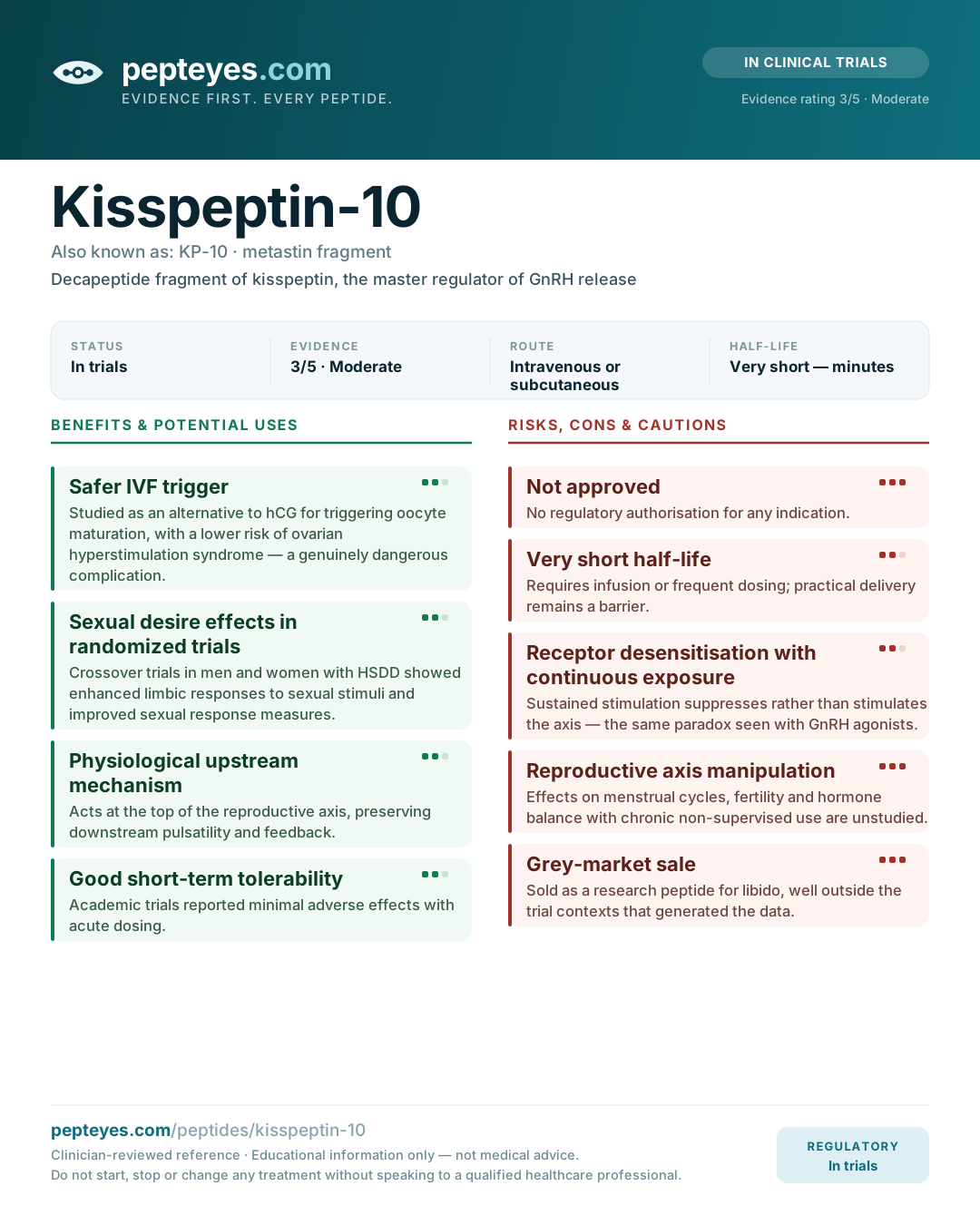
Safer IVF trigger
Studied as an alternative to hCG for triggering oocyte maturation, with a lower risk of ovarian hyperstimulation syndrome — a genuinely dangerous complication.
Evidence: Moderate evidence -
Sexual desire effects in randomized trials
Crossover trials in men and women with HSDD showed enhanced limbic responses to sexual stimuli and improved sexual response measures.
Evidence: Moderate evidence -
Physiological upstream mechanism
Acts at the top of the reproductive axis, preserving downstream pulsatility and feedback.
Evidence: Moderate evidence -
Good short-term tolerability
Academic trials reported minimal adverse effects with acute dosing.
Evidence: Moderate evidence
Risks and cautions
5 entries · 3 serious or common
-
Not approved
No regulatory authorisation for any indication.
Evidence: Serious -
Very short half-life
Requires infusion or frequent dosing; practical delivery remains a barrier.
Evidence: Moderate evidence -
Receptor desensitisation with continuous exposure
Sustained stimulation suppresses rather than stimulates the axis — the same paradox seen with GnRH agonists.
Evidence: Moderate evidence -
Reproductive axis manipulation
Effects on menstrual cycles, fertility and hormone balance with chronic non-supervised use are unstudied.
Evidence: Serious -
Grey-market sale
Sold as a research peptide for libido, well outside the trial contexts that generated the data.
Evidence: Serious
Counts are not a score. A single serious risk can outweigh several well-supported benefits, and a long benefit list built on preclinical work outweighs nothing at all.
Opinion — what people actually report
4 themes · 1 reported benefit · 1 reported problem
This is the weakest tier on this site. These are themes drawn from public discussion — forums, subreddits and patient threads — not from trials. There is no control group, no denominator, and no way to confirm that what someone injected matched its label. People post when a result is dramatic and when something goes wrong, and rarely when nothing happens, so treat everything below as a description of the conversation rather than of the compound. The bars count how often a thing is said, not how well it is supported.
-
Interest runs well ahead of experience Practical note. Dominant theme: Comes up in most discussions of this compound.
Mostly discussed on the strength of research headlines about sexual and reproductive signalling. Few substantive personal accounts exist.
-
Occasional reports of increased libido Reported benefit. Occasional: Reported by a minority, or in specific contexts.
A small number of accounts, difficult to separate from expectation given the framing.
-
Very short half-life is a recognised problem Reported problem. Recurring: Raised regularly, though not by everyone.
Posters note that a peptide cleared in minutes is difficult to use practically, which limits enthusiasm.
-
Confusion with kisspeptin-54 and other fragments Practical note. Recurring: Raised regularly, though not by everyone.
Different fragments are used in different studies and sold interchangeably.
Where the reports and the evidence part ways
Kisspeptin is genuinely important biology — it sits upstream of GnRH and is central to reproductive axis regulation — and there are real human studies, including work on sexual and emotional brain responses and on its use in fertility protocols. Those are controlled research settings with intravenous infusion, not subcutaneous self-administration, and the fragment sold as kisspeptin-10 has a half-life that makes the community protocols pharmacologically implausible. This is a case of legitimate research being cited to support a practice the research did not test.
Cheat sheet
The full sheet, all 77 compounds →The community reference numbers for this compound — reconstitution, working dose, cycle and bloodwork. Research and education only, not medical advice, and not part of the evidence-rated monograph above. Doses assume a 1mL / 100-unit insulin syringe — the calculator does the units for you.
Protocol overview
Dosing & reconstitution 10 mg vial
| WEEK | DAILY DOSE | UNITS PER INJECTION |
|---|---|---|
| Weeks 1 to 2 | 100 mcg | 1 units (0.01 mL) |
| Weeks 3 to 8 (or 3 to 12) | 200 mcg | 2 units (0.02 mL) |
Frequency: Inject once daily subcutaneously. This schedule follows a conservative titration to assess individual response. For 10 unit (0.10 mL) or smaller administrations, consider 30- or 50-unit insulin syringes for improved readability.
On the master sheet
- Vial
- 10mg
- BAC
- 2mL
- Dose
- 100–200mcg daily
- Route
- SubQ fasted
- Cycle
- 4–8 wks
- Time Off
- 2–4 wks
Readers on Kisspeptin-10
Questions and answers from readers, under generated names. Nothing here has been checked or reviewed by the site and none of it is medical advice. It is the least verified thing on this page — and it is here because people ask each other these things anyway, and most of the other places they can ask are run by sellers.
0 questions · 0 answers
No questions yet. Ask the first one above — it takes one box and an email address.
How names work, and the house rules
Names. Every verified address is given one generated name — two ordinary words — and keeps it. Nobody chooses a name and nobody can take another's. Posts marked desk were written by the site's own editorial desk, usually to open a thread; they carry a generated name like everyone else's and are held to the site's rules, which means they never state an amount.
What is not allowed. Selling, sourcing, vendor names, coupon codes and "message me" — posts that read that way are held and usually removed. Personal medical details you would not want public. Abuse. Instructions framed as what someone else should do.
What this is not. A reader's report of what happened to them is a report, not a finding, and an answer here is one person's view. Nothing in this section changes the evidence rating above it. If something you read here would change what you take, take it to a pharmacist or physician first.
Your data. Delete any post of yours at any time, or remove everything you have written together with your name. Details in the privacy notice.
Who should avoid it
- Hormone-sensitive cancers
- Pregnancy
- Unsupervised use for libido
If used under medical supervision, monitor
- LH, FSH, sex hormones if used clinically
- Menstrual cycle tracking
Regulatory & legal status
Investigational only.
Infographic
Where to read further
We link to live literature searches rather than a frozen citation list, so you always see current results — including anything published after our last review.
- PubMed — all published literature on Kisspeptin-10
- PubMed — randomized controlled trials only
- ClinicalTrials.gov — registered human trials
Related peptides in Hormonal & Reproductive
Terms used on this page
- Sexual Desire vs Arousal
- Sexual desire is the motivational interest in sexual activity while arousal is the genital and subjective response to stimulation, and the two dissociate enough that trials measure them separately.
- Kisspeptin
- Kisspeptin is a hypothalamic neuropeptide, the product of the KISS1 gene, that acts on the receptor KISS1R to drive GnRH release and serves as the gatekeeper of puberty and fertility.
- Gonadotropin-Releasing Hormone (GnRH)
- Gonadotropin-releasing hormone is a hypothalamic decapeptide that travels the pituitary portal circulation to trigger LH and FSH release, sitting at the top of the reproductive axis.
- Hypothalamic-Pituitary-Gonadal (HPG) Axis
- The hypothalamic-pituitary-gonadal axis is the GnRH to gonadotropin to gonadal steroid loop that governs puberty, fertility and sex steroid production in both sexes.
- Pulsatile vs Tonic Signalling
- Pulsatile signalling delivers a hormone in discrete bursts whose frequency and amplitude carry the message, while tonic signalling exposes the receptor continuously, and the two can produce opposite effects.
- Agonist
- An agonist is a ligand that binds a receptor and stabilises its active conformation, producing a biological response rather than merely occupying the binding site.
This page is educational information, not medical advice. It cannot account for your medical history, medications, or risk factors. Do not start, stop or change any treatment based on it. Speak to a qualified healthcare professional who knows your case.