Supplied as a finished topical
Skin & Cosmetic
At a glance
Ten answers, each one line. Open any row for the detail behind it.
What it does An extended version of Argireline built on the premise that a longer SNAP-25 mimic…
An extended version of Argireline built on the premise that a longer SNAP-25 mimic competes more effectively in the SNARE complex. The mechanism is coherent; the evidence is thinner than for its predecessor and comes mainly from the supplier.
Half-life Not applicable — topical — Documented
Not applicable — topical
Typical studied dose Set by the formulation, as a percentage of the finished cream or serum… — On the label
Set by the formulation, as a percentage of the finished cream or serum rather than as an amount taken. The concentration used in the published work is the figure worth comparing a product against.
How often it is used Applied as the product directs, usually once or twice a day. Topical… — On the label
Applied as the product directs, usually once or twice a day. Topical results in the published trials came from months of continuous use, not from a short course.
How it is taken Topical — Documented
Topical
Main side effects Evidence base is largely manufacturer-generated · Penetration challenges · Marketing outpaces data — Depends on the study
Evidence base is largely manufacturer-generated — Independent peer-reviewed replication is limited.
Penetration challenges — A larger peptide faces a harder time crossing the stratum corneum than the hexapeptide it extends.
Marketing outpaces data — "Better than Argireline" claims rest on a narrow evidence base.
Storage before mixing A finished cream or serum follows its own label — usually cool, dark and…
A finished cream or serum follows its own label — usually cool, dark and sealed. Copper peptides in particular discolour when they degrade, and a colour change is a reason to stop using it.
Shelf life after mixing Nothing to mix — it is not supplied as a powder. The relevant date is…
Nothing to mix — it is not supplied as a powder. The relevant date is the one printed on the product.
Evidence level 2/5 · Limited — Nothing established
Preclinical work plus scattered human reports, uncontrolled use, or negative trials.
Regulatory status Cosmetic Ingredient — Nothing established
Cosmetic ingredient. Manufacturer studies claim superiority over Argireline; independent replication is limited. Lawful cosmetic ingredient.
Overview
An extended version of Argireline built on the premise that a longer SNAP-25 mimic competes more effectively in the SNARE complex. The mechanism is coherent; the evidence is thinner than for its predecessor and comes mainly from the supplier.
Cosmetic IngredientCosmetic ingredient. Manufacturer studies claim superiority over Argireline; independent replication is limited.
| Regulatory status | Cosmetic ingredient. Manufacturer studies claim superiority over Argireline; independent replication is limited. |
|---|---|
| Drug class | Synthetic octapeptide — an elongated analog of Argireline |
| Route | Topical |
| Half-life | Not applicable — topical |
| Evidence rating |
2/5 Limited
Evidence rating 2 out of 5: Limited
Preclinical work plus scattered human reports, uncontrolled use, or negative trials. |
| Studied in | Manufacturer-sponsored topical studies reporting wrinkle-depth reduction; limited independent published work. |
SNAP-8 (Acetyl Octapeptide-3) sequence & structure
SNAP-8 (Acetyl Octapeptide-3) is a 8-residue linear peptide with a C-terminal amide; molecular weight 1,075.2 Da.
| Three-letter | Ac-Glu-Glu-Met-Gln-Arg-Arg-Ala-Asp-NH2 |
|---|---|
| Length | 8 amino acid residues |
| Modifications |
|
| Molecular formula | C41H70N16O16S |
| Molecular weight | 1,075.2 Da (average, free base) |
| SMILES | C[C@@H](C(=O)N[C@@H](CC(=O)O)C(=O)N)NC(=O)[C@H](CCCN=C(N)N)NC(=O)[C@H](CCCN=C(N)N)NC(=O)[C@H](CCC(=O)N)NC(=O)[C@H](CCSC)NC(=O)[C@H](CCC(=O)O)NC(=O)[C@H](CCC(=O)O)NC(=O)C |
| Identifiers | CAS 868844-74-0 · PubChem CID 76283482 |
| Which molecule | SNAP-8 is the Lipotec/Lubrizol trade name; the INCI name is Acetyl Octapeptide-3, and the FDA/GSRS registry (UNII 8K14HJF88S) lists 'Acetyl Glutamyl Heptapeptide-3' and 'Acetyl octapeptide 1' as synonyms of the same molecule. All of these denote one substance, Ac-EEMQRRAD-NH2, i.e. Argireline (acetyl hexapeptide-8, Ac-EEMQRR-NH2) extended at the C-terminus by Ala-Asp; this record describes that molecule. The pepteyes monograph's aka 'Acetyl glutamyl heptapeptide-1' is not among the registered synonyms (registry has Heptapeptide-3), so the monograph aka should be checked. |
| Sources | PubChem CID 76283482 (Acetyl octapeptide-3), PUG REST properties and isomeric SMILESFDA Substance Registration System, UNII 8K14HJF88S (Acetyl Octapeptide-3; sequence Ac-Glu-Glu-Met-Gln-Arg-Arg-Ala-Asp-NH2, CAS 868844-74-0)NCATS GSRS substance record and names list, UNII 8K14HJF88S (API)Cayman Chemical product 27260 (cross-check: C41H70N16O16S, FW 1075.2, CAS 868844-74-0) |
PubChem carries a second, erroneous record under the same CAS (CID 71587832, C42H72N16O15S, MW 1073.2) whose SMILES contains a spurious enamine (NC(=C)) in place of the Glu1-Glu2 amide bond; the correct structure is CID 76283482 (C41H70N16O16S, MW 1075.2), which matches the FDA/GSRS sequence and Cayman. Vendors quoting MW 1073.2 have copied the wrong PubChem entry. The formula and MW were also recomputed from the sequence here (C41H70N16O16S, 1075.17 Da). Sold as the acetate or TFA salt in cosmetic raw-material grades; a cosmetic ingredient only, not an approved drug.
Record confidence: high — two independent authoritative sources agree on the sequence and modifications. Every sequence on the site is listed with its sources on the peptide sequences index.
How it works
An eight-residue extension of the acetyl hexapeptide sequence, designed for stronger competitive inhibition of SNAP-25 within the SNARE complex, reducing neurotransmitter vesicle docking and muscle contraction intensity.
Evidence base
Rated 2 of 5 — Limited. Preclinical work plus scattered human reports, uncontrolled use, or negative trials.
- Plausible mechanism, limited independent evidence.
Benefits and risks, weighed against the evidence
Every entry below carries the strength of the evidence behind it — three bars for strong human data, two for moderate, one for preliminary or preclinical work. The two columns are not equal by design: where a compound has more documented risk than demonstrated benefit, the lists say so.
Reported benefits
3 entries
-
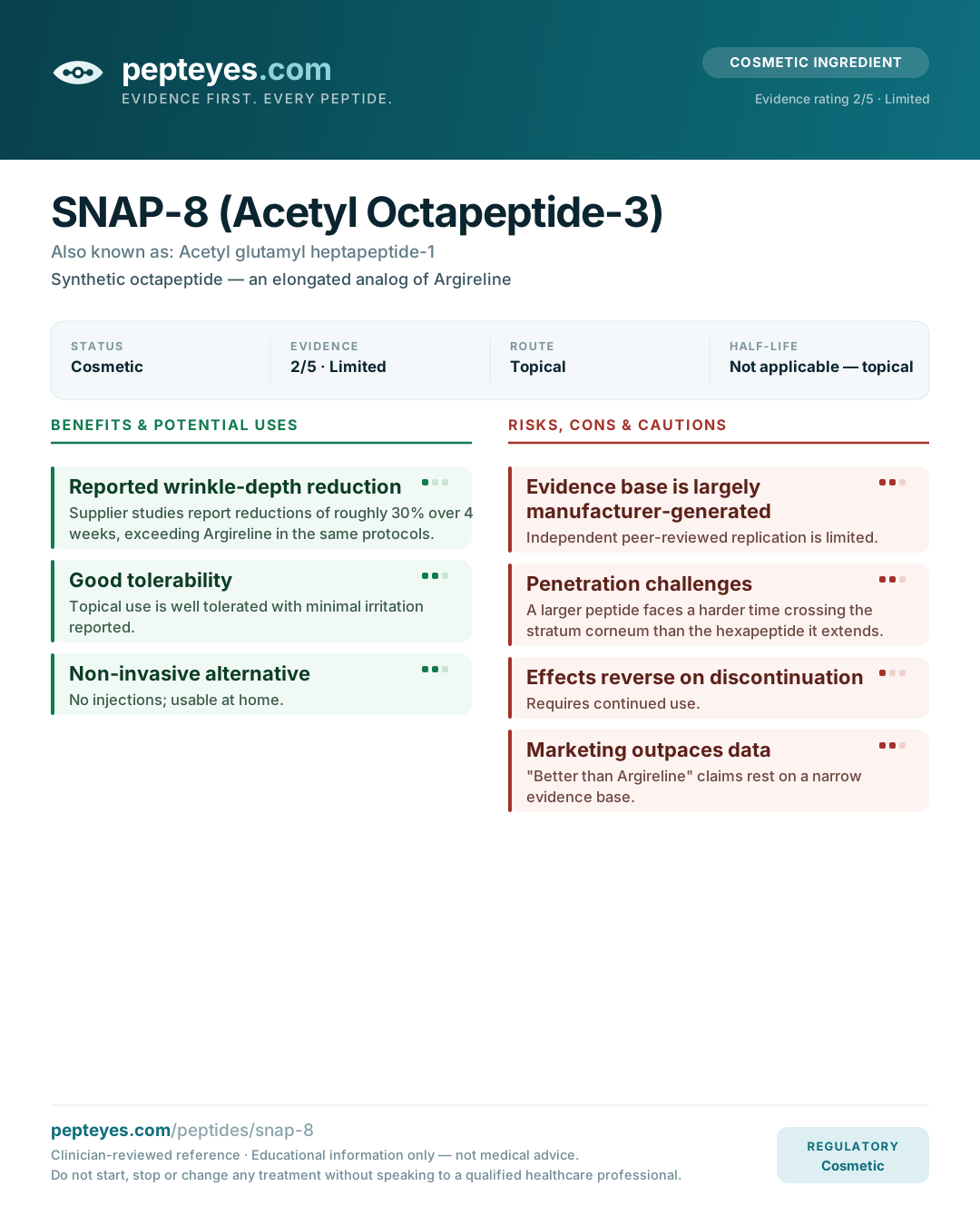
Reported wrinkle-depth reduction
Supplier studies report reductions of roughly 30% over 4 weeks, exceeding Argireline in the same protocols.
Evidence: Preliminary -
Good tolerability
Topical use is well tolerated with minimal irritation reported.
Evidence: Moderate evidence -
Non-invasive alternative
No injections; usable at home.
Evidence: Moderate evidence
Risks and cautions
4 entries
-
Evidence base is largely manufacturer-generated
Independent peer-reviewed replication is limited.
Evidence: Moderate evidence -
Penetration challenges
A larger peptide faces a harder time crossing the stratum corneum than the hexapeptide it extends.
Evidence: Moderate evidence -
Effects reverse on discontinuation
Requires continued use.
Evidence: Minor -
Marketing outpaces data
"Better than Argireline" claims rest on a narrow evidence base.
Evidence: Moderate evidence
Counts are not a score. A single serious risk can outweigh several well-supported benefits, and a long benefit list built on preclinical work outweighs nothing at all.
Opinion — what people actually report
3 themes · 2 reported problems
This is the weakest tier on this site. These are themes drawn from public discussion — forums, subreddits and patient threads — not from trials. There is no control group, no denominator, and no way to confirm that what someone injected matched its label. People post when a result is dramatic and when something goes wrong, and rarely when nothing happens, so treat everything below as a description of the conversation rather than of the compound. The bars count how often a thing is said, not how well it is supported.
-
Treated as a longer version of Argireline Practical note. Dominant theme: Comes up in most discussions of this compound.
Nearly all discussion is comparative, with claims of better efficacy generally traced to supplier marketing.
-
Effects reported as minimal Reported problem. Dominant theme: Comes up in most discussions of this compound.
The dominant theme, in line with the rest of the topical neuropeptide category.
-
Very little independent evidence Reported problem. Recurring: Raised regularly, though not by everyone.
Posters note that almost everything published comes from the manufacturer.
Where the reports and the evidence part ways
SNAP-8 is an octapeptide extension of the Argireline hexapeptide, and the claim that the extra residues improve efficacy comes from supplier data rather than independent research. The published evidence is thinner than for Argireline, which is itself thin. Community expectations here are appropriately low and are better calibrated than the marketing.
Cheat sheet
The full sheet, all 77 compounds →The community reference numbers for this compound — reconstitution, working dose, cycle and bloodwork. Research and education only, not medical advice, and not part of the evidence-rated monograph above. Doses assume a 1mL / 100-unit insulin syringe — the calculator does the units for you.
Protocol overview
Dosing & reconstitution 10 mg vial
| WEEK | DAILY DOSE | UNITS PER INJECTION |
|---|---|---|
| Weeks 1 to 4 | 330 mcg | 3.3 units (0.03 mL) |
| Weeks 5 to 8 | 500 mcg | 5 units (0.05 mL) |
| Weeks 9 to 12 | 1,000 mcg | 10 units (0.10 mL) |
| Weeks 13 to 16 | 1,000 mcg | 10 units (0.10 mL) |
Frequency: Inject once daily subcutaneously. This schedule uses the largest practical dilution to keep per-injection units at or above 10 for better accuracy. The gradual titration allows acclimation while maximizing wrinkle-reduction benefits.
On the master sheet
- Vial
- 10mg
- BAC
- 3mL
- Dose
- 330–1000mcg daily (titrate)
- Route
- SubQ/topical
- Cycle
- 8–12 wks
- Bloodwork
- None standard
Readers on SNAP-8 (Acetyl Octapeptide-3)
Questions and answers from readers, under generated names. Nothing here has been checked or reviewed by the site and none of it is medical advice. It is the least verified thing on this page — and it is here because people ask each other these things anyway, and most of the other places they can ask are run by sellers.
0 questions · 0 answers
No questions yet. Ask the first one above — it takes one box and an email address.
How names work, and the house rules
Names. Every verified address is given one generated name — two ordinary words — and keeps it. Nobody chooses a name and nobody can take another's. Posts marked desk were written by the site's own editorial desk, usually to open a thread; they carry a generated name like everyone else's and are held to the site's rules, which means they never state an amount.
What is not allowed. Selling, sourcing, vendor names, coupon codes and "message me" — posts that read that way are held and usually removed. Personal medical details you would not want public. Abuse. Instructions framed as what someone else should do.
What this is not. A reader's report of what happened to them is a report, not a finding, and an answer here is one person's view. Nothing in this section changes the evidence rating above it. If something you read here would change what you take, take it to a pharmacist or physician first.
Your data. Delete any post of yours at any time, or remove everything you have written together with your name. Details in the privacy notice.
Who should avoid it
- Known ingredient allergy
- Irritated or broken skin
If used under medical supervision, monitor
- None required
Regulatory & legal status
Lawful cosmetic ingredient.
Infographic
Where to read further
We link to live literature searches rather than a frozen citation list, so you always see current results — including anything published after our last review.
- PubMed — all published literature on SNAP-8 (Acetyl Octapeptide-3)
- PubMed — randomized controlled trials only
- ClinicalTrials.gov — registered human trials
Related peptides in Skin & Cosmetic
Terms used on this page
- Stratum Corneum
- The stratum corneum is the outermost epidermal layer of dead, keratin-filled corneocytes in a lipid matrix, and it is the rate-limiting barrier for essentially every topical ingredient.
- Amino Acid Residue
- An amino acid residue is what remains of an amino acid once it has been joined into a chain and a molecule of water has been lost, and residue count is how peptide length is stated.
This page is educational information, not medical advice. It cannot account for your medical history, medications, or risk factors. Do not start, stop or change any treatment based on it. Speak to a qualified healthcare professional who knows your case.