Supplied ready in solution
Hormonal & Reproductive
At a glance
Ten answers, each one line. Open any row for the detail behind it.
What it does The drug that made somatostatin usable.
The drug that made somatostatin usable. Native somatostatin lasts about two minutes; the D-amino acid substitutions here stretch that to an hour and a half and made a whole class of hormone-suppressing therapy possible. Octreotide is the standard of care in acromegaly and in carcinoid syndrome, and it is worth noting on a site like this one that it does the opposite of the growth hormone secretagogues elsewhere in the library.
Half-life About 100 minutes for the immediate-release form, against… — Documented
About 100 minutes for the immediate-release form, against roughly 2 minutes for native somatostatin
Typical studied dose Set on the approved label, which states the starting dose, how it is… — On the label
Set on the approved label, which states the starting dose, how it is increased and the maximum. Read it there rather than anywhere else — including here.
How often it is used Set on the approved label. The interval follows the half-life above… — On the label
Set on the approved label. The interval follows the half-life above, which is why some of these are weekly and others daily.
How it is taken Subcutaneous injection, intramuscular depot every 4 weeks, intravenous… — Documented
Subcutaneous injection, intramuscular depot every 4 weeks, intravenous infusion, or delayed-release oral capsule
Main side effects Gallstones and biliary sludge · Disturbed glucose control in both directions · Gastrointestinal effects on starting — Carries serious risk
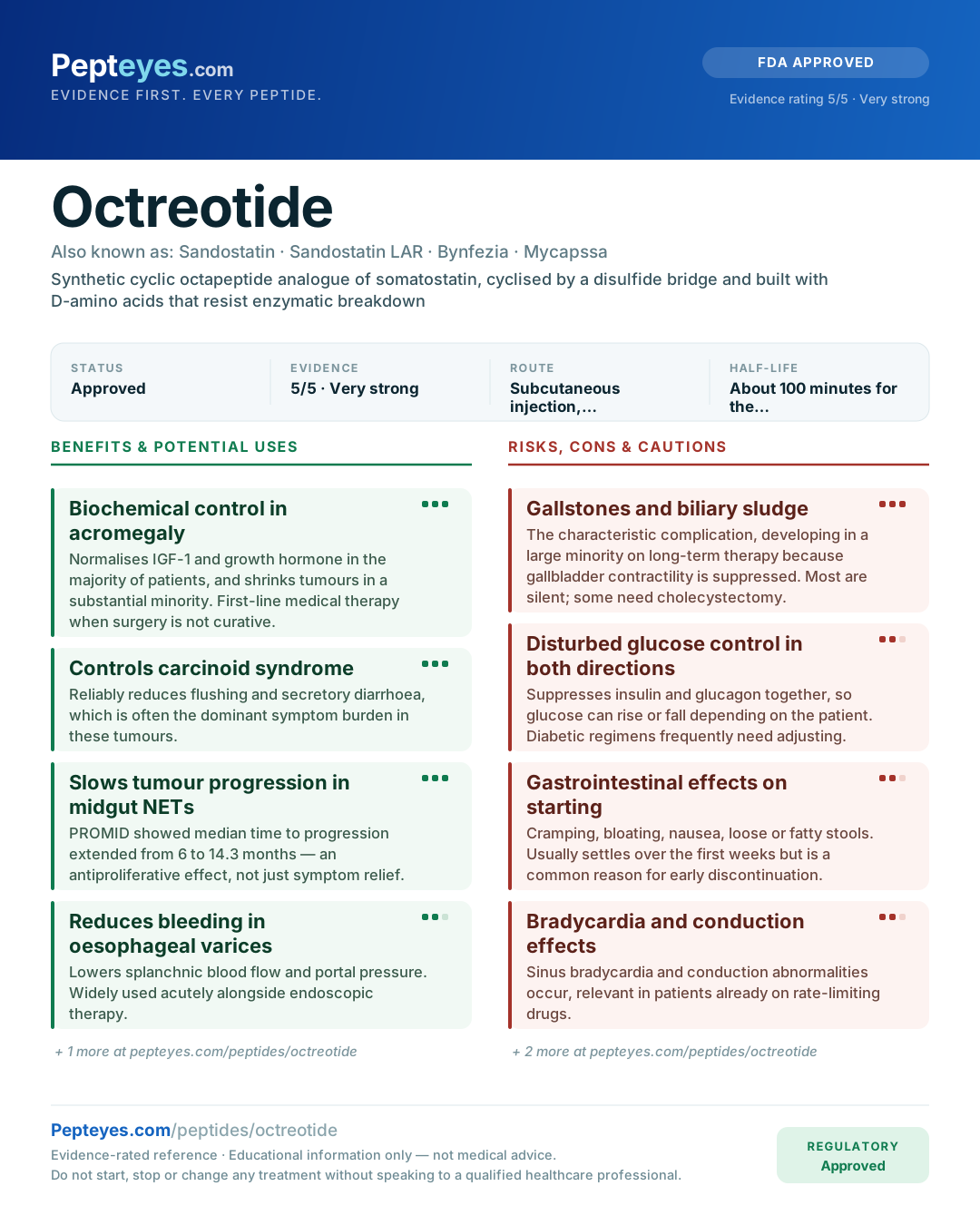
Gallstones and biliary sludge — The characteristic complication, developing in a large minority on long-term therapy because gallbladder contractility is suppressed. Most are silent; some need cholecystectomy.
Disturbed glucose control in both directions — Suppresses insulin and glucagon together, so glucose can rise or fall depending on the patient. Diabetic regimens frequently need adjusting.
Gastrointestinal effects on starting — Cramping, bloating, nausea, loose or fatty stools. Usually settles over the first weeks but is a common reason for early discontinuation.
Storage before mixing Supplied already in solution and kept refrigerated, not frozen. Freezing…
Supplied already in solution and kept refrigerated, not frozen. Freezing a protein solution can aggregate it, which is not always visible.
Shelf life after mixing Nothing to mix — it is not supplied as a powder. The relevant date is…
Nothing to mix — it is not supplied as a powder. The relevant date is the one printed on the product.
Evidence level 5/5 · Very strong — Documented
Multiple phase 3 randomized trials plus regulatory approval in a major market.
Regulatory status FDA Approved — Documented
FDA-approved 1988 for acromegaly and for the diarrhoea of carcinoid and VIPoma tumours. An oral delayed-release capsule was approved in 2020 for maintenance in acromegaly. Prescription-only. Generic injectable forms are widely available; depot and oral forms are not.
Overview
The drug that made somatostatin usable. Native somatostatin lasts about two minutes; the D-amino acid substitutions here stretch that to an hour and a half and made a whole class of hormone-suppressing therapy possible. Octreotide is the standard of care in acromegaly and in carcinoid syndrome, and it is worth noting on a site like this one that it does the opposite of the growth hormone secretagogues elsewhere in the library.
FDA ApprovedFDA-approved 1988 for acromegaly and for the diarrhoea of carcinoid and VIPoma tumours. An oral delayed-release capsule was approved in 2020 for maintenance in acromegaly.
| Regulatory status | FDA-approved 1988 for acromegaly and for the diarrhoea of carcinoid and VIPoma tumours. An oral delayed-release capsule was approved in 2020 for maintenance in acromegaly. |
|---|---|
| Drug class | Synthetic cyclic octapeptide analogue of somatostatin, cyclised by a disulfide bridge and built with D-amino acids that resist enzymatic breakdown |
| Route | Subcutaneous injection, intramuscular depot every 4 weeks, intravenous infusion, or delayed-release oral capsule |
| Half-life | About 100 minutes for the immediate-release form, against roughly 2 minutes for native somatostatin |
| Evidence rating |
5/5 Very strong
Evidence rating 5 out of 5: Very strong
Multiple phase 3 randomized trials plus regulatory approval in a major market. |
| Studied in | Decades of trials in acromegaly show biochemical control in roughly 55–65% of patients on depot therapy. PROMID randomized octreotide LAR in metastatic midgut neuroendocrine tumours and showed a near-tripling of time to progression, establishing an antiproliferative effect beyond symptom control. |
Octreotide sequence & structure
Octreotide is a 8-residue cyclic peptide with a C-terminal alcohol, carrying D-amino acid substitutions, non-standard residues; molecular weight 1,019.26 Da.
lowercase = D-amino acid[bracketed] = non-standard residue
| Three-letter | H-D-Phe-Cys-Phe-D-Trp-Lys-Thr-Cys-Thr-ol |
|---|---|
| Length | 8 amino acid residues |
| Modifications |
|
| Molecular formula | C49H66N10O10S2 |
| Molecular weight | 1,019.26 Da (average, free base) |
| SMILES | C[C@H]([C@H]1C(=O)N[C@@H](CSSC[C@@H](C(=O)N[C@H](C(=O)N[C@@H](C(=O)N[C@H](C(=O)N1)CCCCN)CC2=CNC3=CC=CC=C32)CC4=CC=CC=C4)NC(=O)[C@@H](CC5=CC=CC=C5)N)C(=O)N[C@H](CO)[C@@H](C)O)O |
| Identifiers | CAS 83150-76-9 · PubChem CID 448601 · DrugBank DB00104 |
| Which molecule | Describes octreotide free base (the peptide in Sandostatin, Sandostatin LAR, Bynfezia and Mycapssa, which are all octreotide acetate). Not to be confused with radiolabelled DOTA-conjugated analogs (DOTATATE, DOTATOC) or edotreotide. |
| Sources | FDA label, Sandostatin (octreotide acetate) injection, DESCRIPTIONDailyMed, Mycapssa (octreotide) delayed-release capsules SPL, section 11 DESCRIPTIONPubChem CID 448601 (properties and synonyms)ChEMBL CHEMBL1680DailyMed, Sandostatin injection SPL |
Marketed as the acetate salt; vendor pages often quote the acetate MW (about 1079) rather than the free base (quoted as 1019.2–1019.3 depending on atomic-weight table; ChEMBL 1019.26). The FDA/DailyMed chemical name is D-Phe-L-Cys-L-Phe-D-Trp-L-Lys-L-Thr-N-[2-hydroxy-1-(hydroxymethyl)propyl]-L-cysteinamide, cyclic (2→7)-disulfide, i.e. residue 8 is L-threoninol, so the C-terminus is an alcohol, not an acid or amide.
Record confidence: high — two independent authoritative sources agree on the sequence and modifications. Every sequence on the site is listed with its sources on the peptide sequences index.
How it works
A high-affinity agonist at somatostatin receptor subtypes 2 and 5, with weaker binding at SSTR3. Receptor activation inhibits adenylate cyclase and closes calcium channels in secretory cells, suppressing growth hormone, glucagon, insulin, gastrin, VIP and serotonin release, reducing splanchnic blood flow and slowing gut transit.
Evidence base
Rated 5 of 5 — Very strong. Multiple phase 3 randomized trials plus regulatory approval in a major market.
- Both symptomatic and antiproliferative benefits rest on randomized human trials, which is why this rates a 5.
- Response is receptor-dependent: tumours poor in SSTR2 respond poorly, and imaging can predict this before committing to therapy.
- Roughly a third of acromegaly patients are not controlled on somatostatin analogues and need a different mechanism, such as pegvisomant or pasireotide.
Benefits and risks, weighed against the evidence
Every entry below carries the strength of the evidence behind it — three bars for strong human data, two for moderate, one for preliminary or preclinical work. The two columns are not equal by design: where a compound has more documented risk than demonstrated benefit, the lists say so.
Reported benefits
5 entries · 3 on strong human evidence
-
Biochemical control in acromegaly
Normalises IGF-1 and growth hormone in the majority of patients, and shrinks tumours in a substantial minority. First-line medical therapy when surgery is not curative.
Evidence: Strong evidence -
Controls carcinoid syndrome
Reliably reduces flushing and secretory diarrhoea, which is often the dominant symptom burden in these tumours.
Evidence: Strong evidence -
Slows tumour progression in midgut NETs
PROMID showed median time to progression extended from 6 to 14.3 months — an antiproliferative effect, not just symptom relief.
Evidence: Strong evidence -
Reduces bleeding in oesophageal varices
Lowers splanchnic blood flow and portal pressure. Widely used acutely alongside endoscopic therapy.
Evidence: Moderate evidence -
Reduces output from high-output fistulas
Slows secretion and transit. Evidence is modest and mostly on fistula closure time rather than mortality.
Evidence: Preliminary
Risks and cautions
6 entries · 1 serious or common
-
Gallstones and biliary sludge
The characteristic complication, developing in a large minority on long-term therapy because gallbladder contractility is suppressed. Most are silent; some need cholecystectomy.
Evidence: Serious -
Disturbed glucose control in both directions
Suppresses insulin and glucagon together, so glucose can rise or fall depending on the patient. Diabetic regimens frequently need adjusting.
Evidence: Moderate evidence -
Gastrointestinal effects on starting
Cramping, bloating, nausea, loose or fatty stools. Usually settles over the first weeks but is a common reason for early discontinuation.
Evidence: Moderate evidence -
Bradycardia and conduction effects
Sinus bradycardia and conduction abnormalities occur, relevant in patients already on rate-limiting drugs.
Evidence: Moderate evidence -
Fat-soluble vitamin malabsorption
Follows from suppressed pancreatic exocrine secretion and steatorrhoea during long-term use.
Evidence: Minor -
Vitamin B12 deficiency
Reported with prolonged therapy and worth checking on long-term treatment.
Evidence: Minor
Counts are not a score. A single serious risk can outweigh several well-supported benefits, and a long benefit list built on preclinical work outweighs nothing at all.
Opinion — what people actually report
6 themes · 1 reported benefit · 4 reported problems
This is the weakest tier on this site. These are themes drawn from public discussion — forums, subreddits and patient threads — not from trials. There is no control group, no denominator, and no way to confirm that what someone injected matched its label. People post when a result is dramatic and when something goes wrong, and rarely when nothing happens, so treat everything below as a description of the conversation rather than of the compound. The bars count how often a thing is said, not how well it is supported.
-
Gallstones are treated as when, not if Reported problem. Dominant theme: Comes up in most discussions of this compound.
The most-discussed long-term complication in neuroendocrine tumour and acromegaly communities, with prophylactic ultrasound widely expected.
-
The injection itself is painful Reported problem. Dominant theme: Comes up in most discussions of this compound.
Intramuscular depot administration is a consistent complaint, with technique, needle warming and nurse experience all discussed at length.
-
Symptom control is transformative in carcinoid syndrome Reported benefit. Dominant theme: Comes up in most discussions of this compound.
Among the strongest positive reports in this library — flushing and diarrhoea that dominated daily life brought under control.
-
Steatorrhoea and vitamin deficiencies Reported problem. Recurring: Raised regularly, though not by everyone.
Fatty stools and low B12 come up regularly on long-term therapy, often discovered on routine labs.
-
Glucose moving unpredictably Reported problem. Recurring: Raised regularly, though not by everyone.
Reported in both directions, which patients find confusing until the mechanism is explained.
-
Breakthrough symptoms before the next depot Practical note. Recurring: Raised regularly, though not by everyone.
A common pattern near the end of the dosing interval, managed with short-acting rescue doses.
Where the reports and the evidence part ways
Patient reports and the evidence agree closely here — gallstones, steatorrhoea, glucose disturbance and injection pain are all documented class effects, and the symptom control in carcinoid syndrome is well established. The main thing the community discussion underweights is the antiproliferative effect: PROMID showed octreotide LAR extends time to tumour progression, which means the drug is doing something beyond managing flushing and diarrhoea. Patients focused on symptoms sometimes do not realise that is part of why they are on it.
Readers on Octreotide
Questions and answers from readers, under generated names. Nothing here has been checked or reviewed by the site and none of it is medical advice. It is the least verified thing on this page — and it is here because people ask each other these things anyway, and most of the other places they can ask are run by sellers.
0 questions · 0 answers
No questions yet. Ask the first one above — it takes one box and an email address.
How names work, and the house rules
Names. Every verified address is given one generated name — two ordinary words — and keeps it. Nobody chooses a name and nobody can take another's. Posts marked desk were written by the site's own editorial desk, usually to open a thread; they carry a generated name like everyone else's and are held to the site's rules, which means they never state an amount.
What is not allowed. Selling, sourcing, vendor names, coupon codes and "message me" — posts that read that way are held and usually removed. Personal medical details you would not want public. Abuse. Instructions framed as what someone else should do.
What this is not. A reader's report of what happened to them is a report, not a finding, and an answer here is one person's view. Nothing in this section changes the evidence rating above it. If something you read here would change what you take, take it to a pharmacist or physician first.
Your data. Delete any post of yours at any time, or remove everything you have written together with your name. Details in the privacy notice.
Who should avoid it
- Known hypersensitivity
- Caution in existing gallbladder disease
- Caution in uncontrolled diabetes without a monitoring plan
- Caution in significant bradycardia or conduction disease
If used under medical supervision, monitor
- Gallbladder ultrasound at baseline and periodically
- IGF-1 and growth hormone in acromegaly
- Glucose and HbA1c
- Thyroid function on long-term therapy
- Vitamin B12 on long-term therapy
- Heart rate and ECG where indicated
Regulatory & legal status
Prescription-only. Generic injectable forms are widely available; depot and oral forms are not.
Infographic
Where to read further
We link to live literature searches rather than a frozen citation list, so you always see current results — including anything published after our last review.
- PubMed — all published literature on Octreotide
- PubMed — randomized controlled trials only
- ClinicalTrials.gov — registered human trials
- DailyMed — official FDA prescribing information
Related peptides in Hormonal & Reproductive
Terms used on this page
- Growth Hormone Secretagogue (GHS)
- A growth hormone secretagogue is any compound that stimulates endogenous GH release, a class spanning GHRH analogues and ghrelin-mimetic agents acting at the GHS receptor.
- D-Amino Acid Substitution
- D-amino acid substitution replaces a natural L residue with its mirror image to break protease recognition at that position, greatly extending an analogue's duration of action.
- Somatostatin
- Somatostatin is a cyclic inhibitory peptide, circulating as 14- and 28-residue forms, that suppresses growth hormone release and broadly inhibits endocrine and exocrine secretion.
- Acromegaly
- Acromegaly is the syndrome of sustained growth hormone excess in adults, almost always caused by a pituitary somatotroph adenoma, producing acral and soft-tissue overgrowth with metabolic disease.
- Growth Hormone (GH)
- Growth hormone is a 191-amino-acid pituitary protein secreted in pulses that acts directly on tissues and indirectly through hepatic IGF-1, and is approved for a defined list of indications.
- Glucagon
- Glucagon is a 29-amino-acid pancreatic alpha-cell hormone that raises blood glucose by driving hepatic glycogenolysis and gluconeogenesis, and also increases energy expenditure.
This page is educational information, not medical advice. It cannot account for your medical history, medications, or risk factors. Do not start, stop or change any treatment based on it. Speak to a qualified healthcare professional who knows your case.