Supplied as a lyophilised powder to reconstitute
Cardiac & Vascular
At a glance
Ten answers, each one line. Open any row for the detail behind it.
What it does A cautionary tale worth reading before trusting any surrogate endpoint.
A cautionary tale worth reading before trusting any surrogate endpoint. Nesiritide was approved because it improved breathlessness scores and lowered filling pressures. When a 7,000-patient trial finally asked whether patients did better, the answer was no.
Half-life ~18 minutes — Documented
~18 minutes
Typical studied dose Set on the approved label, which states the starting dose, how it is… — On the label
Set on the approved label, which states the starting dose, how it is increased and the maximum. Read it there rather than anywhere else — including here.
How often it is used Set on the approved label. The interval follows the half-life above… — On the label
Set on the approved label. The interval follows the half-life above, which is why some of these are weekly and others daily.
How it is taken Intravenous infusion — Documented
Intravenous infusion
Main side effects No benefit on death or rehospitalisation · Hypotension · Earlier renal safety controversy — Carries serious risk
No benefit on death or rehospitalisation — ASCEND-HF found no reduction in 30-day mortality or heart failure rehospitalisation. The surrogate endpoints that won approval did not translate.
Hypotension — Significantly more common than with placebo, and often prolonged given the vasodilator mechanism.
Earlier renal safety controversy — Meta-analyses raised concerns about worsening renal function; ASCEND-HF did not confirm renal harm but did not vindicate the drug either.
Storage before mixing As a sealed lyophilised powder, refrigerated is typical and a freezer…
As a sealed lyophilised powder, refrigerated is typical and a freezer suits long storage; both should be dark and dry. A dry powder tolerates a few days out of the cold far better than anything in solution — which is why it ships that way.
Shelf life after mixing Once mixed it is refrigerated and treated as short-lived. Bacteriostatic…
Once mixed it is refrigerated and treated as short-lived. Bacteriostatic water contains a preservative and buys the longer window; sterile water contains none and buys a much shorter one. Peptides in solution also degrade on their own, so the container is only half the question.
Evidence level 5/5 · Very strong — Documented
Multiple phase 3 randomized trials plus regulatory approval in a major market.
Regulatory status FDA Approved — Documented
FDA-approved (2001) for acutely decompensated heart failure. Use collapsed after a large trial showed no benefit on clinical outcomes. Prescription drug; approval retained but clinical use is minimal.
Overview
A cautionary tale worth reading before trusting any surrogate endpoint. Nesiritide was approved because it improved breathlessness scores and lowered filling pressures. When a 7,000-patient trial finally asked whether patients did better, the answer was no.
FDA ApprovedFDA-approved (2001) for acutely decompensated heart failure. Use collapsed after a large trial showed no benefit on clinical outcomes.
| Regulatory status | FDA-approved (2001) for acutely decompensated heart failure. Use collapsed after a large trial showed no benefit on clinical outcomes. |
|---|---|
| Drug class | Recombinant human B-type natriuretic peptide — 32 amino acids |
| Route | Intravenous infusion |
| Half-life | ~18 minutes |
| Evidence rating |
5/5 Very strong
Evidence rating 5 out of 5: Very strong
Multiple phase 3 randomized trials plus regulatory approval in a major market. |
| Studied in | VMAC trial (approval basis, dyspnoea and haemodynamic endpoints); ASCEND-HF, a 7,141-patient outcomes trial. |
Nesiritide sequence & structure
Nesiritide is a 32-residue disulfide-bridged peptide with a free C-terminal acid; molecular weight 3,464.07 Da.
| Three-letter | H-Ser-Pro-Lys-Met-Val-Gln-Gly-Ser-Gly-Cys-Phe-Gly-Arg-Lys-Met-Asp-Arg-Ile-Ser-Ser-Ser-Ser-Gly-Leu-Gly-Cys-Lys-Val-Leu-Arg-Arg-His-OH |
|---|---|
| Length | 32 amino acid residues |
| Modifications |
|
| Molecular formula | C143H244N50O42S4 |
| Molecular weight | 3,464.07 Da (average, free base) |
| Identifiers | CAS 124584-08-3 · PubChem CID 71308561 · DrugBank DB04899 · UniProt P16860 |
| Which molecule | Nesiritide is recombinant human BNP-32, i.e. residues 103–134 of the NPPB precursor (UniProt P16860), identical to the endogenous mature hormone. It is distinct from the 26-residue porcine BNP, from ularitide/urodilatin (an ANP-derived peptide), and from NT-proBNP (precursor residues 27–102), the inactive fragment used as a diagnostic biomarker. |
| Sources | UniProt P16860 (NPPB_HUMAN, precursor with BNP-32 peptide feature 103–134 and Cys112–Cys128 disulfide)ChEMBL CHEMBL1201668 (nesiritide, biotherapeutic sequence)PubChem CID 71308561 (formula, MW, CAS 124584-08-3, UNII P7WI8UL647)KEGG DRUG D05147 nesiritide (full 32-residue sequence, disulfide 10-26, C143H244N50O42S4, MW 3464.05, CAS 124584-08-3)FDA Natrecor (nesiritide) prescribing information, NDA 020920 supplement 36, 2019 (DESCRIPTION: 32 aa rhBNP from E. coli, MW 3464 g/mol, C143H244N50O42S4, citrate salt) |
Natrecor (Scios/Janssen, NDA 020920, now listed as discontinued at Drugs@FDA with no current DailyMed label) was rhBNP expressed in E. coli and formulated as the citrate salt: each 1.5 mg single-use vial contained nesiritide 1.58 mg, citric acid monohydrate 2.1 mg, mannitol 20.0 mg and sodium citrate dihydrate 2.94 mg. Formula/MW refer to the free peptide with the Cys10–Cys26 disulfide formed (label 3464 g/mol; KEGG 3464.05; DrugCentral 3464.07, which also confirms DrugBank DB04899 and UNII P7WI8UL647); vendor 'nesiritide' or 'BNP-32 (human)' is synthetic and usually supplied as a TFA salt.
Record confidence: high — two independent authoritative sources agree on the sequence and modifications. Every sequence on the site is listed with its sources on the peptide sequences index.
How it works
Identical to endogenous BNP. Binds natriuretic peptide receptor A, raising cyclic GMP to produce venous and arterial vasodilation, natriuresis and diuresis, and suppression of the renin-angiotensin-aldosterone and sympathetic systems.
Evidence base
Rated 5 of 5 — Very strong. Multiple phase 3 randomized trials plus regulatory approval in a major market.
- An approval based on surrogate endpoints, overturned in practice by a large outcomes trial — one of the best-documented examples in cardiology.
Benefits and risks, weighed against the evidence
Every entry below carries the strength of the evidence behind it — three bars for strong human data, two for moderate, one for preliminary or preclinical work. The two columns are not equal by design: where a compound has more documented risk than demonstrated benefit, the lists say so.
Reported benefits
4 entries · 2 on strong human evidence
-
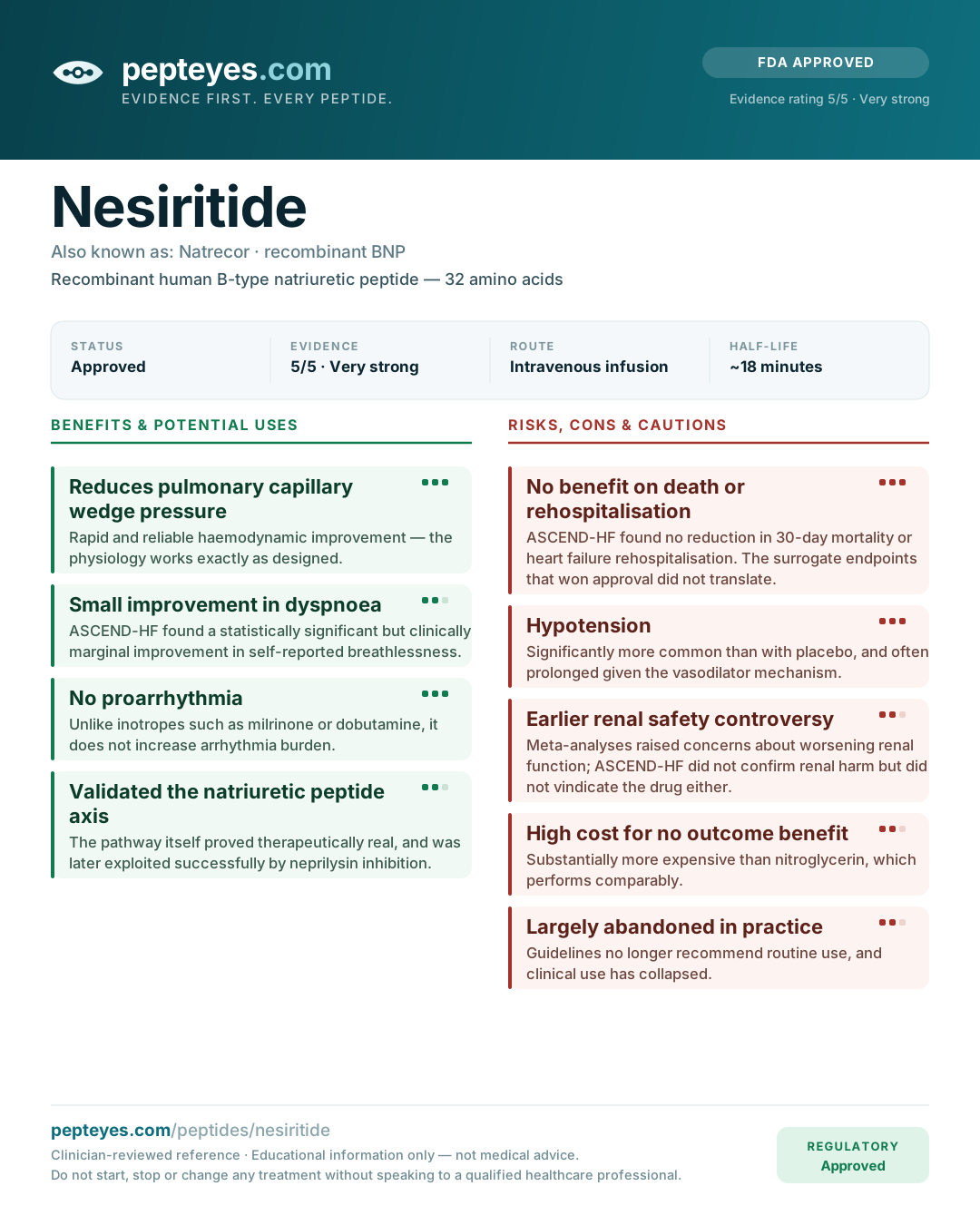
Reduces pulmonary capillary wedge pressure
Rapid and reliable haemodynamic improvement — the physiology works exactly as designed.
Evidence: Strong evidence -
Small improvement in dyspnoea
ASCEND-HF found a statistically significant but clinically marginal improvement in self-reported breathlessness.
Evidence: Moderate evidence -
No proarrhythmia
Unlike inotropes such as milrinone or dobutamine, it does not increase arrhythmia burden.
Evidence: Strong evidence -
Validated the natriuretic peptide axis
The pathway itself proved therapeutically real, and was later exploited successfully by neprilysin inhibition.
Evidence: Moderate evidence
Risks and cautions
5 entries · 2 serious or common
-
No benefit on death or rehospitalisation
ASCEND-HF found no reduction in 30-day mortality or heart failure rehospitalisation. The surrogate endpoints that won approval did not translate.
Evidence: Serious -
Hypotension
Significantly more common than with placebo, and often prolonged given the vasodilator mechanism.
Evidence: Serious -
Earlier renal safety controversy
Meta-analyses raised concerns about worsening renal function; ASCEND-HF did not confirm renal harm but did not vindicate the drug either.
Evidence: Moderate evidence -
High cost for no outcome benefit
Substantially more expensive than nitroglycerin, which performs comparably.
Evidence: Moderate evidence -
Largely abandoned in practice
Guidelines no longer recommend routine use, and clinical use has collapsed.
Evidence: Moderate evidence
Counts are not a score. A single serious risk can outweigh several well-supported benefits, and a long benefit list built on preclinical work outweighs nothing at all.
Opinion — what people actually report
No community discussion to summarise
There is no community self-report for nesiritide. It was an intravenous drug for acutely decompensated heart failure, given in hospital, and its clinical story ended with the ASCEND-HF trial finding no meaningful benefit on symptoms or outcomes. Use collapsed afterwards. Like davunetide, it is a useful reminder that a compound with sound physiological rationale — recombinant B-type natriuretic peptide, promoting vasodilation and diuresis — can still fail to help patients when adequately tested.
Readers on Nesiritide
Questions and answers from readers, under generated names. Nothing here has been checked or reviewed by the site and none of it is medical advice. It is the least verified thing on this page — and it is here because people ask each other these things anyway, and most of the other places they can ask are run by sellers.
0 questions · 0 answers
No questions yet. Ask the first one above — it takes one box and an email address.
How names work, and the house rules
Names. Every verified address is given one generated name — two ordinary words — and keeps it. Nobody chooses a name and nobody can take another's. Posts marked desk were written by the site's own editorial desk, usually to open a thread; they carry a generated name like everyone else's and are held to the site's rules, which means they never state an amount.
What is not allowed. Selling, sourcing, vendor names, coupon codes and "message me" — posts that read that way are held and usually removed. Personal medical details you would not want public. Abuse. Instructions framed as what someone else should do.
What this is not. A reader's report of what happened to them is a report, not a finding, and an answer here is one person's view. Nothing in this section changes the evidence rating above it. If something you read here would change what you take, take it to a pharmacist or physician first.
Your data. Delete any post of yours at any time, or remove everything you have written together with your name. Details in the privacy notice.
Who should avoid it
- Cardiogenic shock
- Systolic blood pressure below 90 mmHg
- Suspected low filling pressures
- Valvular stenosis or constrictive pericarditis
If used under medical supervision, monitor
- Continuous blood pressure monitoring
- Renal function and electrolytes
- Symptom response and fluid balance
Interactions
Not exhaustive. Always have a pharmacist or physician review your full medication list — including supplements.
- ACE inhibitors — additive hypotension
- Other vasodilators — additive hypotension
- Note: BNP assays are confounded during infusion; NT-proBNP is unaffected
Regulatory & legal status
Prescription drug; approval retained but clinical use is minimal.
Infographic
Where to read further
We link to live literature searches rather than a frozen citation list, so you always see current results — including anything published after our last review.
- PubMed — all published literature on Nesiritide
- PubMed — randomized controlled trials only
- ClinicalTrials.gov — registered human trials
- DailyMed — official FDA prescribing information
Related peptides in Cardiac & Vascular
Terms used on this page
- Surrogate Endpoint
- A surrogate endpoint is a laboratory or imaging measure used in place of a clinical outcome, on the assumption that changing the marker will change how patients actually fare.
- Statistical vs Clinical Significance
- Statistical significance says a difference is unlikely to be chance alone, clinical significance says it is large enough to matter to a patient, and a result can satisfy one without the other.
- Placebo and Placebo Control
- A placebo is an inactive intervention matched to the real one in appearance and route, used as a control arm so that improvement caused by the drug can be separated from improvement that would occur anyway.
- Meta-Analysis
- A meta-analysis statistically combines effect estimates from several studies into a pooled estimate, weighting each by its precision, and is a method rather than a grade of evidence.
- Intravenous Administration (IV)
- Intravenous administration delivers drug directly into the bloodstream, giving complete bioavailability by definition and making it the reference route against which all others are measured.
This page is educational information, not medical advice. It cannot account for your medical history, medications, or risk factors. Do not start, stop or change any treatment based on it. Speak to a qualified healthcare professional who knows your case.