Supplied as a nasal solution
Cardiac & Vascular
At a glance
Ten answers, each one line. Open any row for the detail behind it.
What it does A textbook example of what targeted peptide engineering achieves.
A textbook example of what targeted peptide engineering achieves. Two deliberate modifications to vasopressin removed the blood-pressure effect, kept the water-retention effect, and extended the duration — turning a pressor into a safe outpatient medicine with an unexpected second career in bleeding disorders.
Half-life ~3 hours (biological effect considerably longer) — Documented
~3 hours (biological effect considerably longer)
Typical studied dose Set on the approved label, which states the starting dose, how it is… — On the label
Set on the approved label, which states the starting dose, how it is increased and the maximum. Read it there rather than anywhere else — including here.
How often it is used Set on the approved label. The interval follows the half-life above… — On the label
Set on the approved label. The interval follows the half-life above, which is why some of these are weekly and others daily.
How it is taken Oral, intranasal, intravenous or subcutaneous — Documented
Oral, intranasal, intravenous or subcutaneous
Main side effects Hyponatremia — the central risk · Fluid restriction is mandatory, not advisory · Elderly patients are markedly higher risk — Carries serious risk
Hyponatremia — the central risk — Water retention without solute causes dilutional hyponatremia, which can progress to seizures and death. This has caused deaths in nocturia and enuresis treatment, and drove a boxed warning on some formulations.
Fluid restriction is mandatory, not advisory — Patients must limit fluid intake around dosing. Failure to do so is the usual route to severe hyponatremia.
Elderly patients are markedly higher risk — Age-related reduction in free water clearance makes hyponatremia both more likely and more dangerous; some formulations are not recommended over 65.
Storage before mixing Refrigerated, upright and sealed. A nasal solution is usually preserved…
Refrigerated, upright and sealed. A nasal solution is usually preserved, but it is still a solution and the same rules on heat and light apply.
Shelf life after mixing Nothing to mix — it is not supplied as a powder. The relevant date is…
Nothing to mix — it is not supplied as a powder. The relevant date is the one printed on the product.
Evidence level 5/5 · Very strong — Documented
Multiple phase 3 randomized trials plus regulatory approval in a major market.
Regulatory status FDA Approved — Documented
FDA-approved for central diabetes insipidus, primary nocturnal enuresis, nocturia, and for bleeding in mild haemophilia A and von Willebrand disease type 1. Prescription drug across all formulations.
Overview
A textbook example of what targeted peptide engineering achieves. Two deliberate modifications to vasopressin removed the blood-pressure effect, kept the water-retention effect, and extended the duration — turning a pressor into a safe outpatient medicine with an unexpected second career in bleeding disorders.
FDA ApprovedFDA-approved for central diabetes insipidus, primary nocturnal enuresis, nocturia, and for bleeding in mild haemophilia A and von Willebrand disease type 1.
| Regulatory status | FDA-approved for central diabetes insipidus, primary nocturnal enuresis, nocturia, and for bleeding in mild haemophilia A and von Willebrand disease type 1. |
|---|---|
| Drug class | Synthetic vasopressin analog — nonapeptide selective for the V2 receptor |
| Route | Oral, intranasal, intravenous or subcutaneous |
| Half-life | ~3 hours (biological effect considerably longer) |
| Evidence rating |
5/5 Very strong
Evidence rating 5 out of 5: Very strong
Multiple phase 3 randomized trials plus regulatory approval in a major market. |
| Studied in | Decades of trials across diabetes insipidus, nocturia, enuresis, and haemostatic use in mild haemophilia A and von Willebrand disease. |
Desmopressin sequence & structure
Desmopressin is a 9-residue disulfide-bridged peptide with a C-terminal amide, carrying D-amino acid substitutions, non-standard residues; molecular weight 1,069.23 Da.
lowercase = D-amino acid[bracketed] = non-standard residue
| Three-letter | Mpa-Tyr-Phe-Gln-Asn-Cys-Pro-D-Arg-Gly-NH2 |
|---|---|
| Length | 9 amino acid residues |
| Modifications |
|
| Molecular formula | C46H64N14O12S2 |
| Molecular weight | 1,069.23 Da (average, free base) |
| SMILES | N=C(N)NCCC[C@@H](NC(=O)[C@@H]1CCCN1C(=O)[C@@H]1CSSCCC(=O)N[C@@H](Cc2ccc(O)cc2)C(=O)N[C@@H](Cc2ccccc2)C(=O)N[C@@H](CCC(N)=O)C(=O)N[C@@H](CC(N)=O)C(=O)N1)C(=O)NCC(N)=O |
| Identifiers | CAS 16679-58-6 · PubChem CID 5311065 · DrugBank DB00035 |
| Which molecule | Record describes the free-base peptide desmopressin (1-deamino-8-D-arginine vasopressin, INN), which is what the monograph covers across all routes. Marketed products (DDAVP, Minirin, Nocdurna, Noctiva, Stimate) contain desmopressin acetate; FDA labels specify the monoacetate trihydrate (C46H64N14O12S2·C2H4O2·3H2O, MW 1183.34; 4 mcg desmopressin acetate = 3.6 mcg free base). |
| Sources | PubChem CID 5311065 (synonyms: CAS 16679-58-6, UNII ENR1LLB0FP, DrugBank DB00035, CHEMBL1429)ChEBI CHEBI:4450 desmopressin (IUPAC name, formula, mass, CAS)KEGG DRUG D00291 Desmopressin (INN)ChEMBL CHEMBL1429 (canonical SMILES, formula, MW)DailyMed – Desmopressin Acetate Injection, USP label (chemical name, acetate trihydrate formula/MW) |
Sequence is vasopressin with Cys1 deaminated to 3-mercaptopropionic acid and Arg8 in the D configuration (ChEBI IUPAC name ends '-L-prolyl-D-arginylglycinamide'); the cyclic core is closed by the Mpa1–Cys6 disulfide. Average MW of the free base is quoted as 1069.2 (PubChem), 1069.22 (KEGG), 1069.23 (FDA labels), 1069.238 (ChEBI) or 1069.24 (ChEMBL) depending on atomic-weight tables; vendors often list the acetate-salt MW (1183.34 for the trihydrate) or an acetate CAS rather than the free-base CAS 16679-58-6. SMILES is the PubChem/ChEMBL stereoisomer (Arg8 = R = D-Arg), verified identical by InChI.
Record confidence: high — two independent authoritative sources agree on the sequence and modifications. Every sequence on the site is listed with its sources on the peptide sequences index.
How it works
Selective V2 receptor agonism in the renal collecting duct inserts aquaporin-2 channels, concentrating urine. Deamination at position 1 and D-arginine substitution at position 8 remove V1-mediated vasoconstriction and slow degradation. V2 stimulation on endothelium also releases stored von Willebrand factor and factor VIII, which is the basis of the haemostatic indication.
Evidence base
Rated 5 of 5 — Very strong. Multiple phase 3 randomized trials plus regulatory approval in a major market.
- Decades of trials across several distinct indications, each with its own evidence base and its own risk profile.
Benefits and risks, weighed against the evidence
Every entry below carries the strength of the evidence behind it — three bars for strong human data, two for moderate, one for preliminary or preclinical work. The two columns are not equal by design: where a compound has more documented risk than demonstrated benefit, the lists say so.
Reported benefits
5 entries · 5 on strong human evidence
-
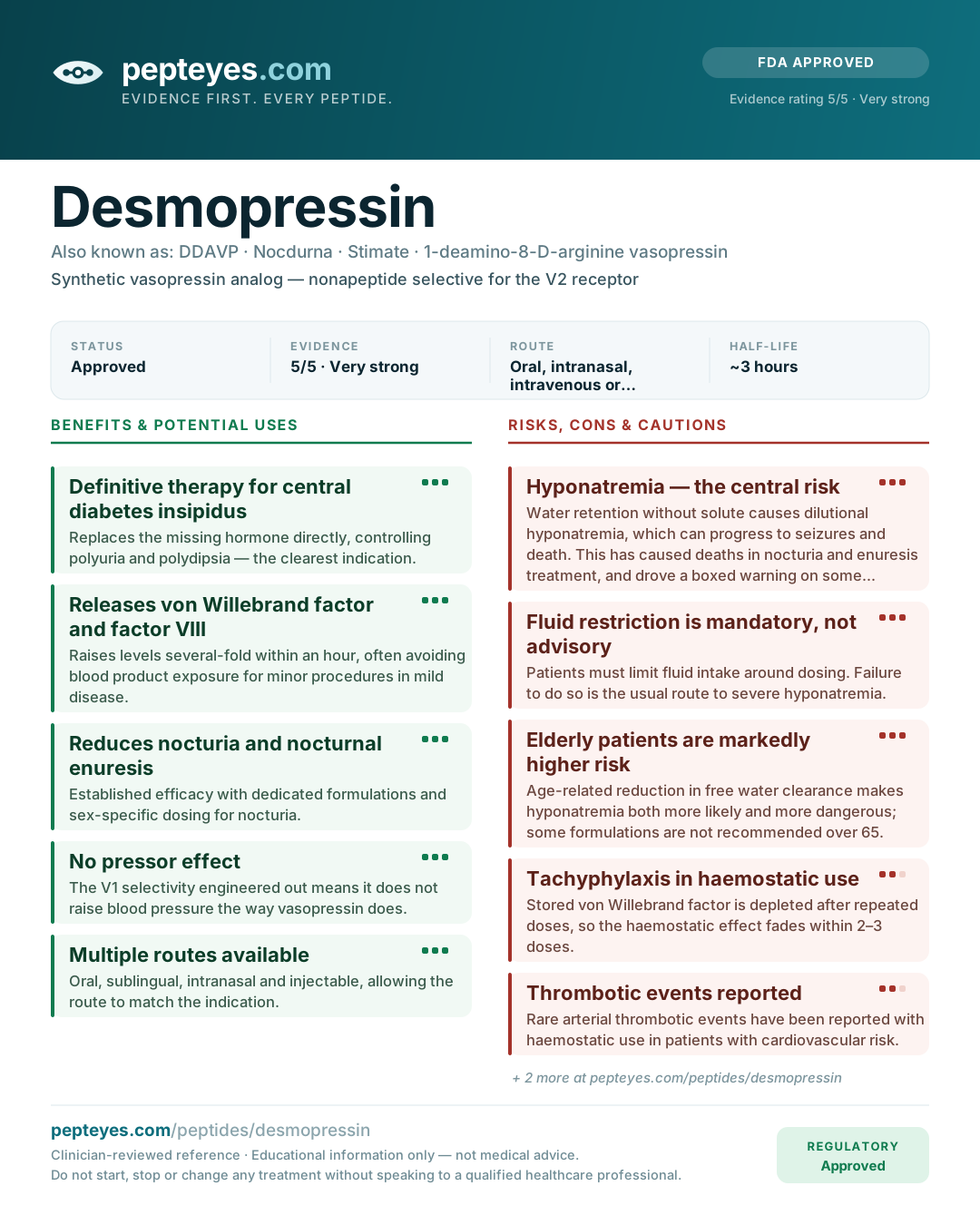
Definitive therapy for central diabetes insipidus
Replaces the missing hormone directly, controlling polyuria and polydipsia — the clearest indication.
Evidence: Strong evidence -
Releases von Willebrand factor and factor VIII
Raises levels several-fold within an hour, often avoiding blood product exposure for minor procedures in mild disease.
Evidence: Strong evidence -
Reduces nocturia and nocturnal enuresis
Established efficacy with dedicated formulations and sex-specific dosing for nocturia.
Evidence: Strong evidence -
No pressor effect
The V1 selectivity engineered out means it does not raise blood pressure the way vasopressin does.
Evidence: Strong evidence -
Multiple routes available
Oral, sublingual, intranasal and injectable, allowing the route to match the indication.
Evidence: Strong evidence
Risks and cautions
7 entries · 3 serious or common
-
Hyponatremia — the central risk
Water retention without solute causes dilutional hyponatremia, which can progress to seizures and death. This has caused deaths in nocturia and enuresis treatment, and drove a boxed warning on some formulations.
Evidence: Serious -
Fluid restriction is mandatory, not advisory
Patients must limit fluid intake around dosing. Failure to do so is the usual route to severe hyponatremia.
Evidence: Serious -
Elderly patients are markedly higher risk
Age-related reduction in free water clearance makes hyponatremia both more likely and more dangerous; some formulations are not recommended over 65.
Evidence: Serious -
Tachyphylaxis in haemostatic use
Stored von Willebrand factor is depleted after repeated doses, so the haemostatic effect fades within 2–3 doses.
Evidence: Moderate evidence -
Thrombotic events reported
Rare arterial thrombotic events have been reported with haemostatic use in patients with cardiovascular risk.
Evidence: Moderate evidence -
Ineffective in nephrogenic diabetes insipidus
The defect is receptor-level, so supplying more hormone does nothing.
Evidence: Moderate evidence -
Nasal formulation variability
Absorption varies with rhinitis and technique; some nasal products were withdrawn over dosing inconsistency.
Evidence: Moderate evidence
Counts are not a score. A single serious risk can outweigh several well-supported benefits, and a long benefit list built on preclinical work outweighs nothing at all.
Opinion — what people actually report
5 themes · 1 reported benefit · 2 reported problems
This is the weakest tier on this site. These are themes drawn from public discussion — forums, subreddits and patient threads — not from trials. There is no control group, no denominator, and no way to confirm that what someone injected matched its label. People post when a result is dramatic and when something goes wrong, and rarely when nothing happens, so treat everything below as a description of the conversation rather than of the compound. The bars count how often a thing is said, not how well it is supported.
-
Fluid restriction is not optional and is easy to get wrong Reported problem. Dominant theme: Comes up in most discussions of this compound.
The most serious recurring theme. Patients and parents describe hyponatraemia warnings as the thing they most needed to understand, and sometimes as something they learned about late.
-
Life-changing for bed-wetting and for diabetes insipidus Reported benefit. Dominant theme: Comes up in most discussions of this compound.
Strongly positive reports, particularly from parents, where the effect on a child's sleepovers and confidence is described as transformative.
-
Headache and nausea as warning signs Reported problem. Recurring: Raised regularly, though not by everyone.
Discussed specifically as the symptoms to treat as an emergency rather than as ordinary side effects.
-
Nasal versus tablet versus melt Practical note. Recurring: Raised regularly, though not by everyone.
Formulation switching is a common topic, with the nasal spray reported as less predictable.
-
Used off-label for nocturia in older adults Practical note. Occasional: Reported by a minority, or in specific contexts.
Discussed with more caution, since hyponatraemia risk rises with age.
Where the reports and the evidence part ways
This is a case where the community is right to be frightened and the evidence agrees. Hyponatraemia is the well-documented serious risk, it is the reason nasal formulations were restricted for some indications, and fluid restriction genuinely is the safety-critical instruction. If anything the divergence is that forums sometimes treat it as a minor convenience drug for bed-wetting, when the mechanism — suppressing free water excretion — is exactly the thing that makes fluid intake dangerous. The transformative effect on quality of life that parents describe is real and is supported by trials.
Readers on Desmopressin
Questions and answers from readers, under generated names. Nothing here has been checked or reviewed by the site and none of it is medical advice. It is the least verified thing on this page — and it is here because people ask each other these things anyway, and most of the other places they can ask are run by sellers.
0 questions · 0 answers
No questions yet. Ask the first one above — it takes one box and an email address.
How names work, and the house rules
Names. Every verified address is given one generated name — two ordinary words — and keeps it. Nobody chooses a name and nobody can take another's. Posts marked desk were written by the site's own editorial desk, usually to open a thread; they carry a generated name like everyone else's and are held to the site's rules, which means they never state an amount.
What is not allowed. Selling, sourcing, vendor names, coupon codes and "message me" — posts that read that way are held and usually removed. Personal medical details you would not want public. Abuse. Instructions framed as what someone else should do.
What this is not. A reader's report of what happened to them is a report, not a finding, and an answer here is one person's view. Nothing in this section changes the evidence rating above it. If something you read here would change what you take, take it to a pharmacist or physician first.
Your data. Delete any post of yours at any time, or remove everything you have written together with your name. Details in the privacy notice.
Who should avoid it
- Hyponatremia or history of hyponatremia
- Moderate to severe renal impairment
- SIADH
- Uncontrolled heart failure
- Polydipsia
- Concurrent loop diuretics or SSRIs (relative — both raise hyponatremia risk)
If used under medical supervision, monitor
- Serum sodium before starting, within the first week, then periodically — non-negotiable in older adults
- Fluid intake around dosing
- Weight and oedema
- Factor VIII and von Willebrand factor levels for haemostatic use
Interactions
Not exhaustive. Always have a pharmacist or physician review your full medication list — including supplements.
- SSRIs, tricyclics, carbamazepine, chlorpropamide — all increase hyponatremia risk
- NSAIDs — increase antidiuretic effect and hyponatremia risk
- Loop diuretics — compound sodium disturbance
- Glucocorticoids — reduce effect
Commonly confused with
These mix-ups cause real harm — two products sold under one name, or two molecules whose effects run in opposite directions.
Oxytocin and vasopressin differ by only two amino acids, which is why high-dose oxytocin causes water retention and hyponatremia. Desmopressin is the engineered vasopressin analog; the two are not interchangeable.
Compare side by sideRegulatory & legal status
Prescription drug across all formulations.
Infographic
Where to read further
We link to live literature searches rather than a frozen citation list, so you always see current results — including anything published after our last review.
- PubMed — all published literature on Desmopressin
- PubMed — randomized controlled trials only
- ClinicalTrials.gov — registered human trials
- DailyMed — official FDA prescribing information
Related peptides in Cardiac & Vascular
Terms used on this page
- Vasopressin
- Vasopressin is a nine-amino-acid posterior pituitary hormone that conserves water through renal V2 receptors and constricts vasculature through V1a receptors, released in response to plasma osmolality.
- D-Amino Acid Substitution
- D-amino acid substitution replaces a natural L residue with its mirror image to break protease recognition at that position, greatly extending an analogue's duration of action.
- Agonist
- An agonist is a ligand that binds a receptor and stabilises its active conformation, producing a biological response rather than merely occupying the binding site.
- Receptor Selectivity
- Receptor selectivity is the degree to which a ligand acts on its intended receptor rather than related ones, expressed as the ratio between its potency at the target and at each off-target.
- Intranasal Delivery
- Intranasal delivery uses the nasal mucosa as an absorption surface, offering needle-free administration and rapid onset but low and variable bioavailability for peptides.
- Sublingual and Buccal Delivery
- Sublingual and buccal delivery route a drug across the mucosa lining the floor of the mouth or the cheek, entering the circulation directly and bypassing gastric acid and hepatic first pass.
This page is educational information, not medical advice. It cannot account for your medical history, medications, or risk factors. Do not start, stop or change any treatment based on it. Speak to a qualified healthcare professional who knows your case.