Supplied as a finished topical
Skin & Cosmetic
At a glance
Ten answers, each one line. Open any row for the detail behind it.
What it does A five-residue peptide, Gly-Pro-Ile-Gly-Ser, pulled out of a Bacillus culture broth during…
A five-residue peptide, Gly-Pro-Ile-Gly-Ser, pulled out of a Bacillus culture broth during a screen of bacterial conditioned media for hair-keratinocyte growth activity. It is unusual among hair peptides in having one genuine randomised, double-blind, vehicle-controlled human trial with measured hair-shaft calibre as the endpoint: 22 Japanese men over four months. That trial is also the whole of the human record. It was small, it was run by the organisation that developed the ingredient, it has never been repeated, and total hair density did not move.
Half-life No pharmacokinetic data exist. It is applied topically to the… — Documented
No pharmacokinetic data exist. It is applied topically to the scalp, so a systemic half-life is not the measure that matters here.
Typical studied dose Set by the formulation, as a percentage of the finished cream or serum… — On the label
Set by the formulation, as a percentage of the finished cream or serum rather than as an amount taken. The concentration used in the published work is the figure worth comparing a product against.
How often it is used Applied as the product directs, usually once or twice a day. Topical… — On the label
Applied as the product directs, usually once or twice a day. Topical results in the published trials came from months of continuous use, not from a short course.
How it is taken Topical, applied to the scalp in a lotion. No injectable or oral use has… — Documented
Topical, applied to the scalp in a lotion. No injectable or oral use has been studied.
Main side effects One small trial is the entire human record · Run by the organisation that developed it · Hair density did not increase — Carries serious risk
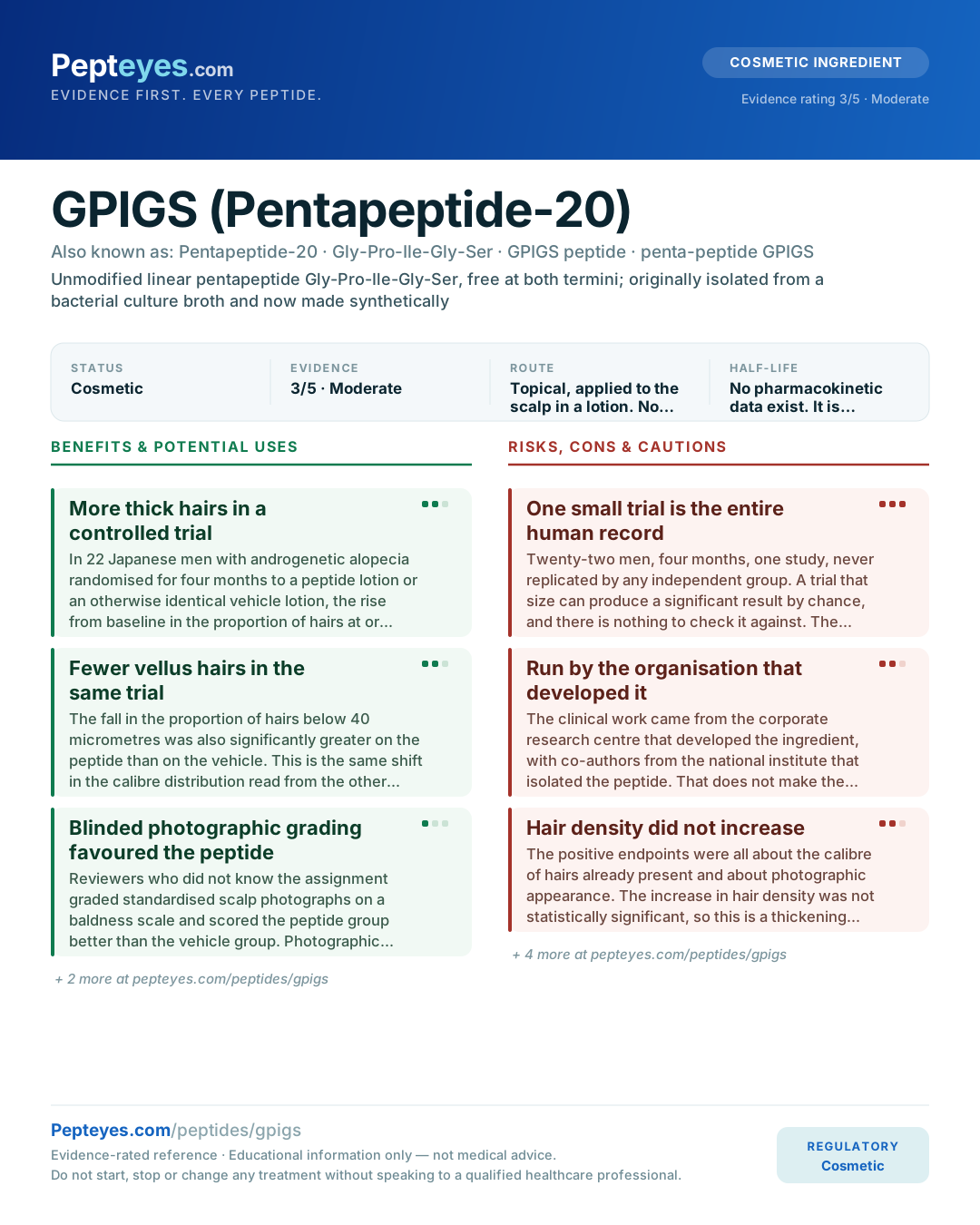
One small trial is the entire human record — Twenty-two men, four months, one study, never replicated by any independent group. A trial that size can produce a significant result by chance, and there is nothing to check it against. The small sample and the absence of replication are the ceiling on everything claimed for this peptide.
Run by the organisation that developed it — The clinical work came from the corporate research centre that developed the ingredient, with co-authors from the national institute that isolated the peptide. That does not make the result wrong, but sponsor-run studies of cosmetic ingredients report positive findings far more often than independent ones do.
Hair density did not increase — The positive endpoints were all about the calibre of hairs already present and about photographic appearance. The increase in hair density was not statistically significant, so this is a thickening signal at best and not evidence of regrowth.
Storage before mixing A finished cream or serum follows its own label — usually cool, dark and…
A finished cream or serum follows its own label — usually cool, dark and sealed. Copper peptides in particular discolour when they degrade, and a colour change is a reason to stop using it.
Shelf life after mixing Nothing to mix — it is not supplied as a powder. The relevant date is…
Nothing to mix — it is not supplied as a powder. The relevant date is the one printed on the product.
Evidence level 3/5 · Moderate — Depends on the study
Small or early-phase human trials, or good controlled topical human data.
Regulatory status Cosmetic Ingredient — Nothing established
Used as a cosmetic ingredient under the INCI name Pentapeptide-20, which denotes this sequence. No drug approval in any market for androgenetic alopecia, and no regulator has assessed it as a hair-loss treatment. Used as a cosmetic ingredient: it carries the INCI name Pentapeptide-20, the cosmetic-ingredient name for this sequence. An INCI name is a naming convention for ingredient labelling, not a medicines approval and not an assessment of benefit. No regulator has authorised the peptide as a treatment for androgenetic alopecia, and a product sold with hair-regrowth claims would be making a drug claim in the US, the EU and most other markets. No trial of it is registered on ClinicalTrials.gov.
Overview
A five-residue peptide, Gly-Pro-Ile-Gly-Ser, pulled out of a Bacillus culture broth during a screen of bacterial conditioned media for hair-keratinocyte growth activity. It is unusual among hair peptides in having one genuine randomised, double-blind, vehicle-controlled human trial with measured hair-shaft calibre as the endpoint: 22 Japanese men over four months. That trial is also the whole of the human record. It was small, it was run by the organisation that developed the ingredient, it has never been repeated, and total hair density did not move.
Cosmetic IngredientUsed as a cosmetic ingredient under the INCI name Pentapeptide-20, which denotes this sequence. No drug approval in any market for androgenetic alopecia, and no regulator has assessed it as a hair-loss treatment.
| Regulatory status | Used as a cosmetic ingredient under the INCI name Pentapeptide-20, which denotes this sequence. No drug approval in any market for androgenetic alopecia, and no regulator has assessed it as a hair-loss treatment. |
|---|---|
| Drug class | Unmodified linear pentapeptide Gly-Pro-Ile-Gly-Ser, free at both termini; originally isolated from a bacterial culture broth and now made synthetically |
| Route | Topical, applied to the scalp in a lotion. No injectable or oral use has been studied. |
| Half-life | No pharmacokinetic data exist. It is applied topically to the scalp, so a systemic half-life is not the measure that matters here. |
| Evidence rating |
3/5 Moderate
Evidence rating 3 out of 5: Moderate
Small or early-phase human trials, or good controlled topical human data. |
| Studied in | Mouse hair bulb keratinocyte culture and telogen mouse regrowth in 2005; human hair keratinocyte proliferation and human hair follicle organ culture ex vivo; and one four-month randomised, double-blind, vehicle-controlled trial in 22 Japanese men with androgenetic alopecia, published in 2016. Those two papers are the entire indexed literature on the molecule. |
GPIGS (Pentapeptide-20) sequence & structure
GPIGS (Pentapeptide-20) is a 5-residue linear peptide with a free C-terminal acid; molecular weight 429.5 Da.
| Three-letter | H-Gly-Pro-Ile-Gly-Ser-OH |
|---|---|
| Length | 5 amino acid residues |
| Modifications | None — an unmodified chain of standard L-amino acids |
| Molecular formula | C18H31N5O7 |
| Molecular weight | 429.5 Da (average, free base) |
| SMILES | CC[C@H](C)[C@@H](C(=O)NCC(=O)N[C@@H](CO)C(=O)O)NC(=O)[C@@H]1CCCN1C(=O)CN |
| Identifiers | PubChem CID 11464549 |
| Which molecule | GPIGS, the cosmetic ingredient Pentapeptide-20 and the 'penta-peptide Gly-Pro-Ile-Gly-Ser' of the 2016 trial all denote the same single molecule: the unmodified all-L pentapeptide with a free N-terminus and a free C-terminal carboxylic acid. This record describes that compound as the free base; salt forms and dilute tradename solutions will quote higher masses. |
| Sources | PubChem CID 11464549, Gly-Pro-Ile-Gly-Ser (formula, mass, isomeric SMILES, InChIKey)Tsuruda et al. 2005, Biol Pharm Bull 28:485-489 — isolation and identification of GPIGS (PMID 15744074)Iwabuchi et al. 2016, J Cosmet Dermatol 15:176-184 — the clinical trial naming the sequence (PMID 27030543)Cosmetic Ingredients Guide entry for Pentapeptide-20 (INCI name to sequence cross-reference) |
The sequence is stated outright in the titles and methods of both primary papers, and the structure follows from it because nothing is modified. Formula and average mass were recomputed from residue composition as 429.47 Da and agree with PubChem's C18H31N5O7 / 429.5. No CAS registry number appeared in any source consulted, so none is recorded rather than guessed; the INCI name Pentapeptide-20 comes from cosmetic ingredient databases, since the peptide papers give the sequence but no INCI designation.
Record confidence: high — two independent authoritative sources agree on the sequence and modifications. Every sequence on the site is listed with its sources on the peptide sequences index.
How it works
The peptide was found by screening conditioned media from 298 bacterial cultures for something that made hair bulb keratinocytes divide. The active fraction, from Bacillus sp. M18, was purified in three steps — a resin batch step, gel chromatography and reverse-phase HPLC — and identified as GPIGS. In those cells it raised Akt phosphorylation, and the growth response was inhibited by the PI3-kinase inhibitor LY294002, which places the effect on the PI3K/Akt proliferation axis rather than on androgen metabolism. Nothing published shows it inhibits 5-alpha-reductase, blocks the androgen receptor or touches any pathway the approved alopecia drugs work through. The clinical logic offered is that a matrix keratinocyte population kept proliferating builds a thicker shaft, which fits the trial's finding of a shift from vellus towards thick hairs with no change in the number of hairs.
Evidence base
Rated 3 of 5 — Moderate. Small or early-phase human trials, or good controlled topical human data.
- Rated 3. There is one genuine randomised, double-blind, vehicle-controlled human trial with an objective hair-calibre endpoint, which is more than almost any other hair peptide can show. The rating is capped at 3 by a sample of 22 men, a single four-month study and no replication.
- The human hair keratinocyte proliferation assay and the human hair follicle organ culture are in-vitro and ex-vivo experiments on human tissue, not clinical trials. On their own they would rate 1, and they should not be described as human evidence of benefit.
- The tested lotion contained the peptide against an otherwise identical vehicle, so the trial result is attributable to the peptide itself rather than to a blend. A comparable trial of a multi-ingredient formulation could not have isolated the peptide and would rate lower.
- The isolation work and the clinical trial share authors and come from the corporate research centre and the national institute that developed the peptide. Neither has been reproduced by an unrelated group.
- Hair density did not change significantly. Only shaft calibre and blinded photographic grading moved, which is a narrower claim than it is usually marketed as.
Benefits and risks, weighed against the evidence
Every entry below carries the strength of the evidence behind it — three bars for strong human data, two for moderate, one for preliminary or preclinical work. The two columns are not equal by design: where a compound has more documented risk than demonstrated benefit, the lists say so.
Reported benefits
5 entries
-
More thick hairs in a controlled trial
In 22 Japanese men with androgenetic alopecia randomised for four months to a peptide lotion or an otherwise identical vehicle lotion, the rise from baseline in the proportion of hairs at or above 60 micrometres was significantly greater on the peptide than on the vehicle.
Evidence: Moderate evidence -
Fewer vellus hairs in the same trial
The fall in the proportion of hairs below 40 micrometres was also significantly greater on the peptide than on the vehicle. This is the same shift in the calibre distribution read from the other end, not an independent second finding.
Evidence: Moderate evidence -
Blinded photographic grading favoured the peptide
Reviewers who did not know the assignment graded standardised scalp photographs on a baldness scale and scored the peptide group better than the vehicle group. Photographic grading is a soft endpoint, but blinding the graders is the right way to run it.
Evidence: Preliminary -
A measured mechanism in the relevant cell type
Unlike many hair peptides, the proliferative effect was traced to a pathway in the cells it is supposed to act on: raised Akt phosphorylation in hair bulb keratinocytes, blocked by a PI3-kinase inhibitor, alongside hair shaft elongation in human follicle organ culture.
Evidence: Preliminary -
No treatment-related skin reactions reported
The four-month trial recorded no adverse dermatological effects attributed to treatment, and the peptide is applied topically rather than systemically. Twenty-two men over four months cannot detect anything uncommon, so this is reassurance rather than a safety dataset.
Evidence: Preliminary
Risks and cautions
7 entries · 1 serious or common
-
One small trial is the entire human record
Twenty-two men, four months, one study, never replicated by any independent group. A trial that size can produce a significant result by chance, and there is nothing to check it against. The small sample and the absence of replication are the ceiling on everything claimed for this peptide.
Evidence: Serious -
Run by the organisation that developed it
The clinical work came from the corporate research centre that developed the ingredient, with co-authors from the national institute that isolated the peptide. That does not make the result wrong, but sponsor-run studies of cosmetic ingredients report positive findings far more often than independent ones do.
Evidence: Moderate evidence -
Hair density did not increase
The positive endpoints were all about the calibre of hairs already present and about photographic appearance. The increase in hair density was not statistically significant, so this is a thickening signal at best and not evidence of regrowth.
Evidence: Moderate evidence -
No comparison with minoxidil or finasteride
The peptide was compared only with a vehicle lotion. Nothing indicates how the effect stands against the treatments for androgenetic alopecia that actually carry regulatory approval, and reviewers of the hair-peptide literature have made exactly that criticism of this trial.
Evidence: Moderate evidence -
Cosmetic lawfulness is not evidence of efficacy
Carrying an INCI name and appearing in cosmetic ingredient databases is a naming and labelling convention for cosmetic use. It is not a finding that the ingredient grows or thickens hair, and no regulator has assessed it for that purpose.
Evidence: Moderate evidence -
Delivery to the hair bulb is unverified
The proposed mechanism acts on matrix keratinocytes deep in the follicle, so the peptide has to get there. The trial measured an outcome, not penetration, and nothing published shows how much of an applied peptide reaches the bulb.
Evidence: Moderate evidence -
Nothing is known beyond four months
No published work follows anyone past four months, so whether the shift in hair calibre continues, plateaus, or reverses once application stops has simply not been studied.
Evidence: Minor
Counts are not a score. A single serious risk can outweigh several well-supported benefits, and a long benefit list built on preclinical work outweighs nothing at all.
Opinion — what people actually report
No community discussion to summarise
There is nothing to summarise for GPIGS. Under its cosmetic name, pentapeptide-20, it appears on a handful of ingredient lists and in ingredient databases, and that is the whole of its public footprint — no forum threads, no experience reports, no arguments about it in either direction. Hair-loss communities that dissect copper peptides and Wnt-pathway compounds at length have simply never picked it up, which is striking, because it has the one thing most of those compounds lack: a randomised, double-blind, vehicle-controlled human trial with a measured endpoint. Attention in this field does not track evidence, and this is the plainest example of that in the library.
Readers on GPIGS (Pentapeptide-20)
Questions and answers from readers, under generated names. Nothing here has been checked or reviewed by the site and none of it is medical advice. It is the least verified thing on this page — and it is here because people ask each other these things anyway, and most of the other places they can ask are run by sellers.
0 questions · 0 answers
No questions yet. Ask the first one above — it takes one box and an email address.
How names work, and the house rules
Names. Every verified address is given one generated name — two ordinary words — and keeps it. Nobody chooses a name and nobody can take another's. Posts marked desk were written by the site's own editorial desk, usually to open a thread; they carry a generated name like everyone else's and are held to the site's rules, which means they never state an amount.
What is not allowed. Selling, sourcing, vendor names, coupon codes and "message me" — posts that read that way are held and usually removed. Personal medical details you would not want public. Abuse. Instructions framed as what someone else should do.
What this is not. A reader's report of what happened to them is a report, not a finding, and an answer here is one person's view. Nothing in this section changes the evidence rating above it. If something you read here would change what you take, take it to a pharmacist or physician first.
Your data. Delete any post of yours at any time, or remove everything you have written together with your name. Details in the privacy notice.
Who should avoid it
- Known allergy to the peptide or to other ingredients in the formulation
- Broken, inflamed or infected scalp skin
- Hair loss that has not been assessed — scarring alopecias, alopecia areata and telogen effluvium are different conditions and need a diagnosis rather than a cosmetic
If used under medical supervision, monitor
- Standardised photographs taken from a fixed position and distance, since a change in hair calibre is not visible without them
- Scalp irritation, redness or itching at the application site
- A reassessment if shedding worsens or the pattern of loss changes
Interactions
Not exhaustive. Always have a pharmacist or physician review your full medication list — including supplements.
- Topical minoxidil — no combination study exists; the two have never been tested together and each vehicle can irritate the scalp on its own
Regulatory & legal status
Used as a cosmetic ingredient: it carries the INCI name Pentapeptide-20, the cosmetic-ingredient name for this sequence. An INCI name is a naming convention for ingredient labelling, not a medicines approval and not an assessment of benefit. No regulator has authorised the peptide as a treatment for androgenetic alopecia, and a product sold with hair-regrowth claims would be making a drug claim in the US, the EU and most other markets. No trial of it is registered on ClinicalTrials.gov.
Infographic
What this entry was checked against
The specific records this monograph was verified against on its last research pass. We link live literature searches below as well, because these are a snapshot and the literature is not.
- Iwabuchi et al. 2016, J Cosmet Dermatol 15(2):176-184 — the randomised, double-blind trial in 22 Japanese men (PMID 27030543)
- Tsuruda et al. 2005, Biol Pharm Bull 28(3):485-489 — bacterial screen, isolation of GPIGS and the PI3K/Akt mechanism (PMID 15744074)
- Overview of Short Peptides for Hair Loss, Biomedicines 2026;14:864 — review placing the GPIGS trial and its limitations in context
- PubChem CID 11464549, Gly-Pro-Ile-Gly-Ser — molecular formula, mass and structure
- Cosmetic Ingredients Guide entry for Pentapeptide-20 — INCI name, sequence and declared cosmetic function
- ClinicalTrials.gov API query for GPIGS and Pentapeptide-20 — no registered study returned
Where to read further
We link to live literature searches rather than a frozen citation list, so you always see current results — including anything published after our last review.
- PubMed — all published literature on GPIGS (Pentapeptide-20)
- PubMed — randomized controlled trials only
- ClinicalTrials.gov — registered human trials
Related peptides in Skin & Cosmetic
Terms used on this page
- Blinding
- Blinding is the withholding of treatment-assignment knowledge from participants, clinicians, outcome assessors or analysts, so that expectation and behaviour cannot bias what a trial measures.
- Reversed-Phase HPLC (RP-HPLC)
- Reversed-phase HPLC separates peptides on a nonpolar stationary phase using a rising organic gradient, ordering them broadly by hydrophobicity for both analysis and preparative purification.
- Phosphorylation
- Phosphorylation is the attachment of a phosphate group to a serine, threonine or tyrosine hydroxyl, adding 80 daltons and two negative charges, and it is the main switch by which cells relay a receptor signal.
- Keratinocyte
- Keratinocytes are the cells that make up almost all of the epidermis, differentiating from the basal layer upward and dying in a programmed way to build the stratum corneum barrier.
- Statistical vs Clinical Significance
- Statistical significance says a difference is unlikely to be chance alone, clinical significance says it is large enough to matter to a patient, and a result can satisfy one without the other.
- Mechanism of Action (MOA)
- A mechanism of action is the molecular account of what a drug binds and what that binding does, traced through to the physiological change that produces the clinical effect.
This page is educational information, not medical advice. It cannot account for your medical history, medications, or risk factors. Do not start, stop or change any treatment based on it. Speak to a qualified healthcare professional who knows your case.