Supplied as a lyophilised powder to reconstitute
Antimicrobial & Antibiotic
At a glance
Ten answers, each one line. Open any row for the detail behind it.
What it does An antibiotic that was shelved for being too toxic and brought back because the…
An antibiotic that was shelved for being too toxic and brought back because the alternative became no antibiotic at all. Its return is one of the clearest markers of how far Gram-negative resistance has progressed.
Half-life Colistimethate prodrug ~2-3 h IV; formed colistin itself 3-18… — Documented
Colistimethate prodrug ~2-3 h IV; formed colistin itself 3-18 h, around 14 h in critically ill patients.
Typical studied dose Set on the approved label, which states the starting dose, how it is… — On the label
Set on the approved label, which states the starting dose, how it is increased and the maximum. Read it there rather than anywhere else — including here.
How often it is used Set on the approved label. The interval follows the half-life above… — On the label
Set on the approved label. The interval follows the half-life above, which is why some of these are weekly and others daily.
How it is taken Intravenous, inhaled, or topical — Documented
Intravenous, inhaled, or topical
Main side effects Nephrotoxicity in a large fraction of patients · Neurotoxicity · Confusing dosing units — Carries serious risk
Nephrotoxicity in a large fraction of patients — Acute kidney injury occurs in a substantial proportion of treated patients and is the dominant limitation on its use.
Neurotoxicity — Paraesthesia, dizziness, ataxia and, rarely, neuromuscular blockade causing respiratory arrest — particularly with concurrent neuromuscular blocking agents.
Confusing dosing units — Colistimethate is dosed in international units in some countries and in colistin base activity milligrams in others. Unit confusion has caused serious dosing errors.
Storage before mixing As a sealed lyophilised powder, refrigerated is typical and a freezer…
As a sealed lyophilised powder, refrigerated is typical and a freezer suits long storage; both should be dark and dry. A dry powder tolerates a few days out of the cold far better than anything in solution — which is why it ships that way.
Shelf life after mixing Once mixed it is refrigerated and treated as short-lived. Bacteriostatic…
Once mixed it is refrigerated and treated as short-lived. Bacteriostatic water contains a preservative and buys the longer window; sterile water contains none and buys a much shorter one. Peptides in solution also degrade on their own, so the container is only half the question.
Evidence level 4/5 · Strong — Documented
Consistent human randomized trials, or approval outside the United States.
Regulatory status FDA Approved — Documented
FDA-approved. Abandoned in the 1970s for toxicity, then reintroduced as a last-resort agent against multidrug-resistant Gram-negative organisms. Prescription antibiotic reserved for resistant infections.
Overview
An antibiotic that was shelved for being too toxic and brought back because the alternative became no antibiotic at all. Its return is one of the clearest markers of how far Gram-negative resistance has progressed.
FDA ApprovedFDA-approved. Abandoned in the 1970s for toxicity, then reintroduced as a last-resort agent against multidrug-resistant Gram-negative organisms.
| Regulatory status | FDA-approved. Abandoned in the 1970s for toxicity, then reintroduced as a last-resort agent against multidrug-resistant Gram-negative organisms. |
|---|---|
| Drug class | Cyclic cationic polypeptide antibiotic with a fatty acyl tail |
| Route | Intravenous, inhaled, or topical |
| Half-life | Colistimethate prodrug ~2-3 h IV; formed colistin itself 3-18 h, around 14 h in critically ill patients. |
| Evidence rating |
4/5 Strong
Evidence rating 4 out of 5: Strong
Consistent human randomized trials, or approval outside the United States. |
| Studied in | Extensive observational and registry data in carbapenem-resistant infection; randomized trials comparing colistin monotherapy with combination regimens. |
Colistin (Polymyxin E) sequence & structure
Colistin (Polymyxin E) is a 10-residue cyclic peptide with a free C-terminal acid, carrying a fatty-acid side chain, D-amino acid substitutions, non-standard residues; molecular weight 1,169.48 Da.
lowercase = D-amino acid[bracketed] = non-standard residue
| Three-letter | (S)-6-Methyloctanoyl-Dab-Thr-Dab-cyclo[Dab-Dab-D-Leu-Leu-Dab-Dab-Thr] |
|---|---|
| Length | 10 amino acid residues |
| Modifications |
|
| Molecular formula | C53H100N16O13 |
| Molecular weight | 1,169.48 Da (average, free base) |
| SMILES | CC[C@H](C)CCCCC(=O)N[C@@H](CCN)C(=O)N[C@@H]([C@@H](C)O)C(=O)N[C@@H](CCN)C(=O)N[C@H]1CCNC(=O)[C@@H](NC(=O)[C@@H](NC(=O)[C@@H](NC(=O)[C@@H](NC(=O)[C@H](NC(=O)[C@@H](NC1=O)CCN)CC(C)C)CC(C)C)CCN)CCN)[C@@H](C)O |
| Identifiers | CAS 7722-44-3 · PubChem CID 24825758 · DrugBank DB00803 |
| Which molecule | Colistin (polymyxin E) is a fermentation product of Paenibacillus (Bacillus) polymyxa var. colistinus and is a mixture of closely related lipopeptides sharing one decapeptide sequence but differing in the N-acyl fatty acid; this record describes the principal component colistin A (polymyxin E1, (S)-6-methyloctanoyl tail, C53H100N16O13, CAS 7722-44-3). Colistin B (polymyxin E2) carries a 6-methylheptanoyl tail (C52H98N16O13, MW 1155.45). CAS 1066-17-7 refers to the colistin mixture, 1264-72-8 to colistin sulfate. The pepteyes monograph also lists colistimethate sodium (Coly-Mycin M; pentasodium colistin methanesulfonate, C58H105N16Na5O28S5, MW ~1750) among its names: that is the sulfomethylated prodrug used parenterally, which is hydrolysed in vivo to the active colistin described here, and is not the free base. |
| Sources | ChEBI CHEBI:59064 (colistin A)PubChem CID 24825758 (Colistin A)ChEMBL CHEMBL3781027 (colistin A)PubChem CID 5311054 (Colistin)DailyMed - Coly-Mycin M Parenteral (colistimethate sodium) label |
Numbering follows the polymyxin convention Dab1-Thr2-Dab3-Dab4-Dab5-D-Leu6-Leu7-Dab8-Dab9-Thr10 with the fatty acid on Dab1 and the ring closed from Dab4 to Thr10 (ChEBI IUPAC name: 4,10-anhydro{N-[6-methyloctanoyl]-L-Dab-L-Thr-L-Dab-L-Dab-L-Dab-D-Leu-L-Leu-L-Dab-L-Dab-L-Thr}); colistin differs from polymyxin B only at position 6 (D-Leu vs D-Phe). ChEBI, PubChem and ChEMBL agree on the peptide sequence, stereochemistry, formula (C53H100N16O13), MW (1169.48) and CAS 7722-44-3, but ChEBI draws the fatty-acid C6 as (6R) whereas PubChem and ChEMBL give (6S), the configuration of the natural (S)-6-methyloctanoic acid used in polymyxin total syntheses; the (S) form is recorded here. Commercial colistin sulfate is dosed by weight or IU of the mixture, whereas colistimethate sodium products are labelled in mg of colistin base activity; the PubChem 'Colistin' record (CID 5311054) depicts a 6-methylheptanoyl (colistin B-type, C52H98N16O13) structure, so CID 24825758 is used here. DrugBank DB00803 returns HTTP 403 to automated fetches and is confirmed only via PubChem and Wikipedia cross-references.
Record confidence: high — two independent authoritative sources agree on the sequence and modifications. Every sequence on the site is listed with its sources on the peptide sequences index.
How it works
The polycationic peptide binds lipid A in the Gram-negative outer membrane, displacing the divalent cations that stabilise lipopolysaccharide. The membrane becomes permeable and the cell dies. The same affinity for anionic membranes explains its renal and neurological toxicity.
Evidence base
Rated 4 of 5 — Strong. Consistent human randomized trials, or approval outside the United States.
- Largely observational modern evidence — it re-entered practice out of necessity rather than through a trial program.
Benefits and risks, weighed against the evidence
Every entry below carries the strength of the evidence behind it — three bars for strong human data, two for moderate, one for preliminary or preclinical work. The two columns are not equal by design: where a compound has more documented risk than demonstrated benefit, the lists say so.
Reported benefits
4 entries · 1 on strong human evidence
-
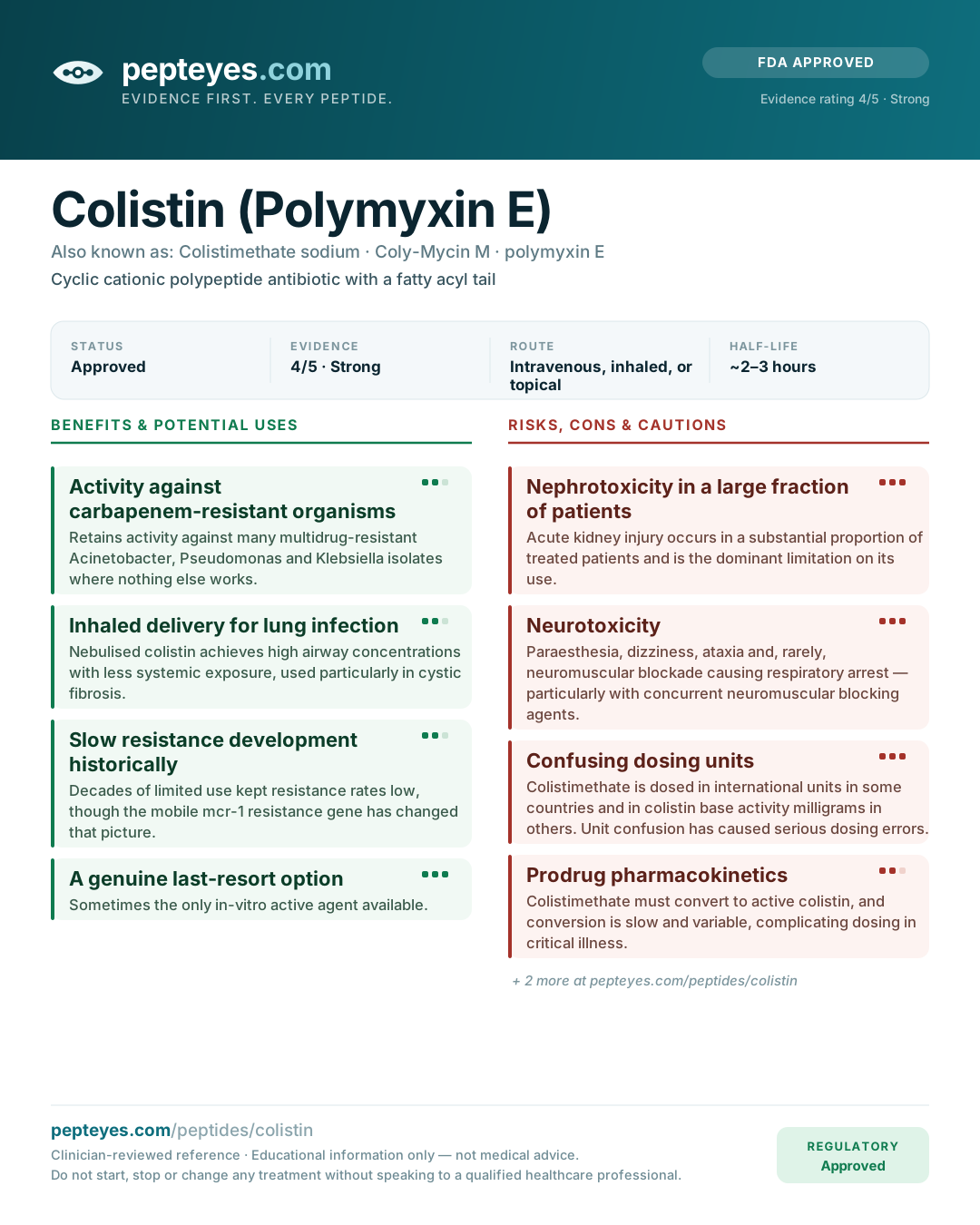
Activity against carbapenem-resistant organisms
Retains activity against many multidrug-resistant Acinetobacter, Pseudomonas and Klebsiella isolates where nothing else works.
Evidence: Moderate evidence -
Inhaled delivery for lung infection
Nebulised colistin achieves high airway concentrations with less systemic exposure, used particularly in cystic fibrosis.
Evidence: Moderate evidence -
Slow resistance development historically
Decades of limited use kept resistance rates low, though the mobile mcr-1 resistance gene has changed that picture.
Evidence: Moderate evidence -
A genuine last-resort option
Sometimes the only in-vitro active agent available.
Evidence: Strong evidence
Risks and cautions
6 entries · 4 serious or common
-
Nephrotoxicity in a large fraction of patients
Acute kidney injury occurs in a substantial proportion of treated patients and is the dominant limitation on its use.
Evidence: Serious -
Neurotoxicity
Paraesthesia, dizziness, ataxia and, rarely, neuromuscular blockade causing respiratory arrest — particularly with concurrent neuromuscular blocking agents.
Evidence: Serious -
Confusing dosing units
Colistimethate is dosed in international units in some countries and in colistin base activity milligrams in others. Unit confusion has caused serious dosing errors.
Evidence: Serious -
Prodrug pharmacokinetics
Colistimethate must convert to active colistin, and conversion is slow and variable, complicating dosing in critical illness.
Evidence: Moderate evidence -
Emerging plasmid-mediated resistance
The mcr-1 gene confers transferable colistin resistance and has spread internationally, largely driven by agricultural use.
Evidence: Serious -
Weak evidence base by modern standards
Reintroduced without the trial program a new drug would require today.
Evidence: Moderate evidence
Counts are not a score. A single serious risk can outweigh several well-supported benefits, and a long benefit list built on preclinical work outweighs nothing at all.
Opinion — what people actually report
No community discussion to summarise
No community self-report exists for colistin. It is a last-line antibiotic for multidrug-resistant Gram-negative infection, given in intensive care or by inhalation in cystic fibrosis, with nephrotoxicity that requires close monitoring. It is used when nothing else works, which is the opposite of an elective decision — and its renewed use after decades of shelving is a story about antimicrobial resistance rather than about patient preference.
Readers on Colistin (Polymyxin E)
Questions and answers from readers, under generated names. Nothing here has been checked or reviewed by the site and none of it is medical advice. It is the least verified thing on this page — and it is here because people ask each other these things anyway, and most of the other places they can ask are run by sellers.
0 questions · 0 answers
No questions yet. Ask the first one above — it takes one box and an email address.
How names work, and the house rules
Names. Every verified address is given one generated name — two ordinary words — and keeps it. Nobody chooses a name and nobody can take another's. Posts marked desk were written by the site's own editorial desk, usually to open a thread; they carry a generated name like everyone else's and are held to the site's rules, which means they never state an amount.
What is not allowed. Selling, sourcing, vendor names, coupon codes and "message me" — posts that read that way are held and usually removed. Personal medical details you would not want public. Abuse. Instructions framed as what someone else should do.
What this is not. A reader's report of what happened to them is a report, not a finding, and an answer here is one person's view. Nothing in this section changes the evidence rating above it. If something you read here would change what you take, take it to a pharmacist or physician first.
Your data. Delete any post of yours at any time, or remove everything you have written together with your name. Details in the privacy notice.
Who should avoid it
- Concurrent neuromuscular blocking agents where avoidable
- Myasthenia gravis
- Pre-existing severe renal impairment (dose adjustment mandatory)
- Use when a less toxic active agent is available
If used under medical supervision, monitor
- Serum creatinine daily in critical illness
- Neurological examination for paraesthesia and weakness
- Careful verification of dosing units
- Culture and susceptibility to confirm no better option exists
Interactions
Not exhaustive. Always have a pharmacist or physician review your full medication list — including supplements.
- Neuromuscular blocking agents — risk of prolonged paralysis and respiratory arrest
- Aminoglycosides and vancomycin — additive nephrotoxicity
- Loop diuretics — additive renal risk
Regulatory & legal status
Prescription antibiotic reserved for resistant infections.
Infographic
Where to read further
We link to live literature searches rather than a frozen citation list, so you always see current results — including anything published after our last review.
- PubMed — all published literature on Colistin (Polymyxin E)
- PubMed — randomized controlled trials only
- ClinicalTrials.gov — registered human trials
- DailyMed — official FDA prescribing information
Related peptides in Antimicrobial & Antibiotic
Terms used on this page
- Endotoxin (Lipopolysaccharide)
- Endotoxin is the lipopolysaccharide of Gram-negative outer membranes, a heat-stable TLR4 agonist that causes fever and shock at nanogram doses and that sterilisation does not remove.
- Fibrosis
- Fibrosis is the accumulation of excess extracellular matrix that replaces functional tissue, representing repair that has failed to resolve rather than a separate disease process.
This page is educational information, not medical advice. It cannot account for your medical history, medications, or risk factors. Do not start, stop or change any treatment based on it. Speak to a qualified healthcare professional who knows your case.