Elamipretide (SS-31) vs MOTS-c
Two mitochondrial peptides at opposite ends of the evidence scale.
The distinction that mattersBoth marketed as mitochondrial peptides. Elamipretide completed multiple phase 3 trials and holds an approval for one ultra-rare disease; MOTS-c has never been given to humans in a controlled trial.
These are not equivalent in evidence Elamipretide (SS-31) is rated 4/5 and MOTS-c is rated 1/5 — a gap of 3 levels on our scale. Similar marketing does not mean similar proof.
| Elamipretide (SS-31) FDA Approved | MOTS-c Research Use Only | |
|---|---|---|
| Evidence rating |
4/5 Strong
Evidence rating 4 out of 5: Strong
|
1/5 Minimal
Evidence rating 1 out of 5: Minimal
|
| Regulatory status | Approved in the US for Barth syndrome, an ultra-rare mitochondrial disorder. Trials in primary mitochondrial myopathy and dry AMD did not meet primary endpoints. | Not approved. Active academic research subject; no completed human efficacy trials. |
| Category | Longevity & Mitochondrial | Longevity & Mitochondrial |
| Drug class | Cardiolipin-targeting mitochondrial tetrapeptide | Mitochondrial-derived peptide — 16 amino acids encoded in mitochondrial DNA |
| Route | Subcutaneous | Subcutaneous (research) |
| Half-life | ~2–4 hours | Not characterised. No pharmacokinetic study of MOTS-c has been published in humans or in any animal species. The phase 1 programme of the analogue CB4211 collected pharmacokinetic data but never released it. In vitro plasma work done for doping control identified four rapid degradation products and two oxidation products, which is consistent with a short-lived unmodified peptide — but that is an inference from metabolite chemistry, not a measured half-life. |
| Sequence length | 4 residues | 16 residues |
| Molecular weight | 639.8 Da | 2,174.6 Da |
| Studied in | Phase 3 trials in primary mitochondrial myopathy (MMPOWER-3), Barth syndrome (TAZPOWER and extension), dry age-related macular degeneration, and heart failure. | Mouse and rat metabolic, exercise, liver and cardiac models; human observational work correlating plasma MOTS-c with metabolic health, exercise and longevity phenotypes. MOTS-c itself entered human testing for the first time in February 2026, in a Phase 2a randomised, double-blind, placebo-controlled trial in adults with prediabetes and overweight or obesity (NCT07505745; industry-sponsored, one listed site, 120 participants planned, insulin sensitivity at 12 weeks as the efficacy endpoint) — recruiting, with no results. Separately, a modified MOTS-c analogue, CB4211, completed a randomised placebo-controlled phase 1 programme in 2021 (NCT03998514) whose results were never published or posted to the registry. |
| Who should avoid it |
|
|
| Legal status | Approved for a single ultra-rare indication. Research-grade "SS-31" is a separate, unapproved product. | Not approved for human use. |
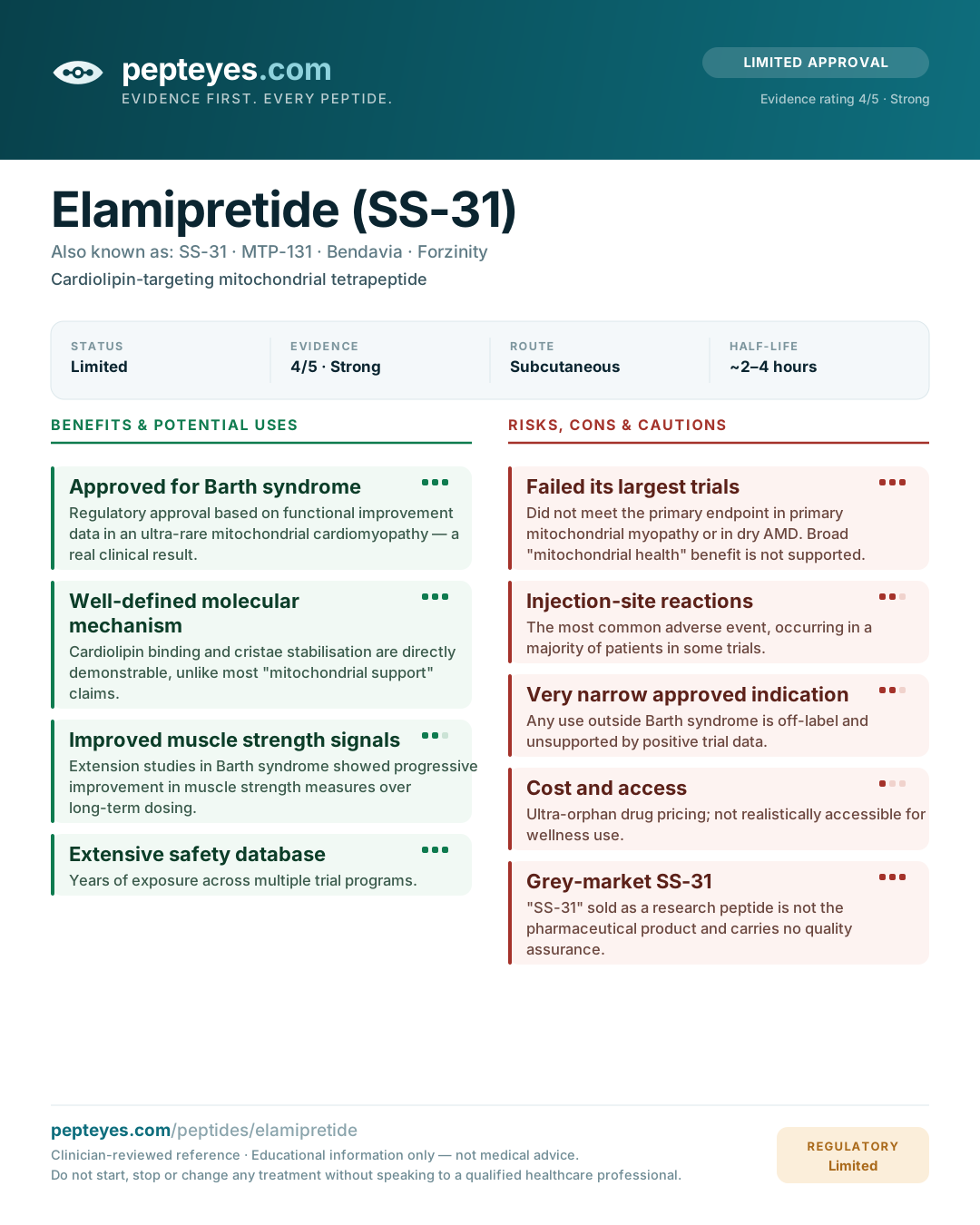
Benefits — Elamipretide (SS-31)
- Approved for Barth syndrome
Regulatory approval based on functional improvement data in an ultra-rare mitochondrial cardiomyopathy — a real clinical result.
- Well-defined molecular mechanism
Cardiolipin binding and cristae stabilisation are directly demonstrable, unlike most "mitochondrial support" claims.
- Improved muscle strength signals
Extension studies in Barth syndrome showed progressive improvement in muscle strength measures over long-term dosing.
- Extensive safety database
Years of exposure across multiple trial programs.
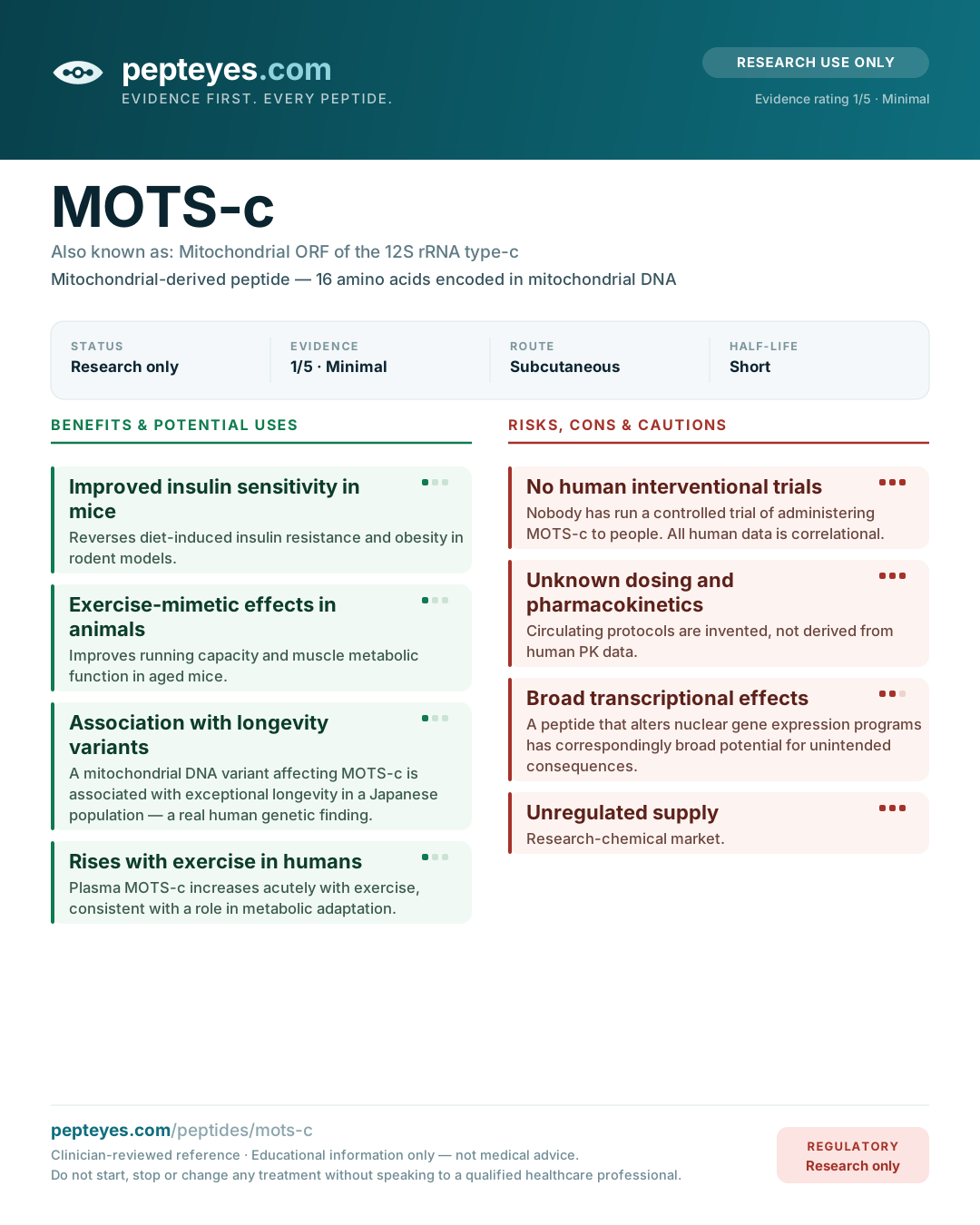
Benefits — MOTS-c
- Improved insulin sensitivity in mice
Reverses diet-induced insulin resistance and obesity in rodent models.
- Exercise-mimetic effects in animals
Improves running capacity and muscle metabolic function in aged mice.
- A human genetic signal that later reversed direction
A mitochondrial variant altering MOTS-c was proposed as a longevity factor from a small Japanese centenarian sample. A far larger follow-up by the same consortium, across three cohorts and tens of thousands of people, found no lifespan effect in the expanded data and instead associated the variant with higher type 2 diabetes prevalence in men, with reduced peptide activity in cell and mouse experiments. It is a genuine human finding, and it now points the other way.
- Rises with exercise in humans
Plasma MOTS-c increases acutely with exercise, consistent with a role in metabolic adaptation.
- A metabolic signal in the only human trial of a MOTS-c analogue
CB4211, a modified MOTS-c analogue, was tested in a randomised, placebo-controlled, triple-masked phase 1 programme of 88 participants that completed in 2021. Its four-week stage in roughly twenty adults with fatty liver disease was reported to show reductions in ALT and AST, lower glucose and a trend to lower body weight versus placebo. Read that carefully: these were exploratory pharmacodynamic endpoints inside a safety and pharmacokinetic study, the findings were announced only by company press release and have never been published or posted to the registry, and the sponsor later stated the formulation used was not suitable for further development. It is the closest thing to human efficacy evidence anywhere in this family, and it is very thin.
Risks & cons — Elamipretide (SS-31)
- Failed its largest trials
Did not meet the primary endpoint in primary mitochondrial myopathy or in dry AMD. Broad "mitochondrial health" benefit is not supported.
- Injection-site reactions
The most common adverse event, occurring in a majority of patients in some trials.
- Very narrow approved indication
Any use outside Barth syndrome is off-label and unsupported by positive trial data.
- Cost and access
Ultra-orphan drug pricing; not realistically accessible for wellness use.
- Grey-market SS-31
"SS-31" sold as a research peptide is not the pharmaceutical product and carries no quality assurance.
Risks & cons — MOTS-c
- No completed human trial, and none with results
Everything claimed for MOTS-c in people rests on correlational data. The first randomised placebo-controlled trial of the peptide itself began recruiting in 2026 — a phase 2 study in prediabetes and overweight, with insulin sensitivity as its endpoint and primary completion scheduled for 2027 — so as of now no controlled trial has reported. The only MOTS-c analogue previously taken into humans was suspended during phase 1 to address injection-site reactions, and its results were never published.
- Unknown dosing and pharmacokinetics
Circulating protocols are invented, not derived from human PK data.
- Broad transcriptional effects
A peptide that alters nuclear gene expression programs has correspondingly broad potential for unintended consequences.
- Unregulated supply
Research-chemical market.
- Prohibited in sport at all times
MOTS-c is named explicitly on the WADA 2026 Prohibited List, under S4.4.1 as an activator of AMP-activated protein kinase alongside AICAR and BAM15, and is prohibited both in and out of competition. Substances in class S4.4 are non-Specified, meaning an adverse finding carries the standard sanction without the mitigation route available for Specified substances. This is also detectable rather than theoretical: anti-doping laboratories validated a plasma mass-spectrometry method for MOTS-c, four of its metabolites and two oxidation products in 2019, explicitly for doping control.
A comparison is not a recommendation. Neither column is being suggested for you. Which — if either — is appropriate depends on your diagnosis, history and medications, and that is a conversation for a qualified clinician.