Biotinoyl Tripeptide-1 (Biotinyl-GHK) vs GHK-Cu
The distinction that mattersBoth are the same GHK tripeptide carrying something extra, and both are sold for hair, so the names get swapped constantly. GHK-Cu is a coordination complex in which a copper ion is held by the peptide, and much of its claimed activity is attributed to copper delivery. Biotinoyl tripeptide-1 contains no copper: biotin is covalently bonded to the N-terminus, a permanent chemical change rather than a bound metal.
These are not equivalent in evidence GHK-Cu is rated 3/5 and Biotinoyl Tripeptide-1 (Biotinyl-GHK) is rated 2/5 — a gap of 1 level on our scale. Similar marketing does not mean similar proof.
| Biotinoyl Tripeptide-1 (Biotinyl-GHK) Cosmetic Ingredient | GHK-Cu Cosmetic Ingredient | |
|---|---|---|
| Evidence rating |
2/5 Limited
Evidence rating 2 out of 5: Limited
|
3/5 Moderate
Evidence rating 3 out of 5: Moderate
|
| Regulatory status | A lawful cosmetic ingredient with no drug approval anywhere. The EU ingredient inventory lists it as a hair-conditioning agent, which is a labelling classification, not a regulator's finding that it grows hair. | Established cosmetic ingredient with human topical data. Injectable use is unapproved and unstudied. |
| Category | Skin & Cosmetic | Skin & Cosmetic |
| Drug class | Vitamin-peptide conjugate: the tripeptide GHK (Gly-His-Lys) with biotin amide-bonded to the glycine N-terminus | Naturally occurring copper-binding tripeptide |
| Route | Topical, in leave-on scalp, brow and lash formulations | Topical (well studied); injectable (not studied) |
| Half-life | Not applicable — topical and non-systemic; no human pharmacokinetics have been published | Commonly quoted as 30–60 minutes — that figure is an estimate repeated by suppliers and search summaries, not a measurement, and the same sources elsewhere give 1–2 hours or 4. No human pharmacokinetic study of GHK-Cu has been published for any route, so there is no measured half-life to report. What is established: rat work shows the tripeptide is cleared from plasma and broken to the dipeptide His-Lys, and once the peptide bonds are cut the copper does not leave with it but transfers to albumin, so the copper outlasts the peptide by far. Endogenous plasma GHK falls with age, but that is a concentration, not a half-life. |
| Sequence length | 3 residues | 3 residues |
| Molecular weight | 566.7 Da | 401.9 Da |
| Studied in | On the peptide alone: cultured human hair-follicle explants over fourteen days and an eighteen-hour skin-explant localisation study, both commissioned by the ingredient manufacturer. The gene array in that dossier tested the blend, not the peptide. In people, only blend trials: a four-month randomised placebo-controlled study in 35 men, then add-on trials with minoxidil or PRP. | A handful of small controlled human studies: a randomised, evaluator-blinded, vehicle-controlled trial of a copper tripeptide gel in diabetic foot ulcers (whose larger 511-patient successor failed), a maker-funded 8-week split-face wrinkle trial in 40 women, a small trial after laser resurfacing that was negative on blinded measures, and an 18-person eyebrow study. The cosmetic facial and eye-cream results were reported as 2002 conference abstracts rather than papers, and no controlled trial supports GHK-Cu alone for scalp hair. The bulk of the literature is fibroblast and keratinocyte culture plus rodent wound, lung and liver models. No controlled human study of any injected route. |
| Who should avoid it |
|
|
| Legal status | A lawful cosmetic ingredient in the United States, the European Union and the United Kingdom, listed in the EU cosmetic ingredient inventory as a hair-conditioning agent under Regulation 1223/2009. It holds no marketing authorisation as a medicine anywhere. That boundary constrains claims: in the US a product claiming to regrow hair or to treat androgenetic alopecia is making a drug claim and would need approval, and in the EU such a claim is outside what a cosmetic may say. It is not a controlled substance and is not named on the WADA Prohibited List. | Lawful as a cosmetic ingredient. Injectable preparations are unapproved. |
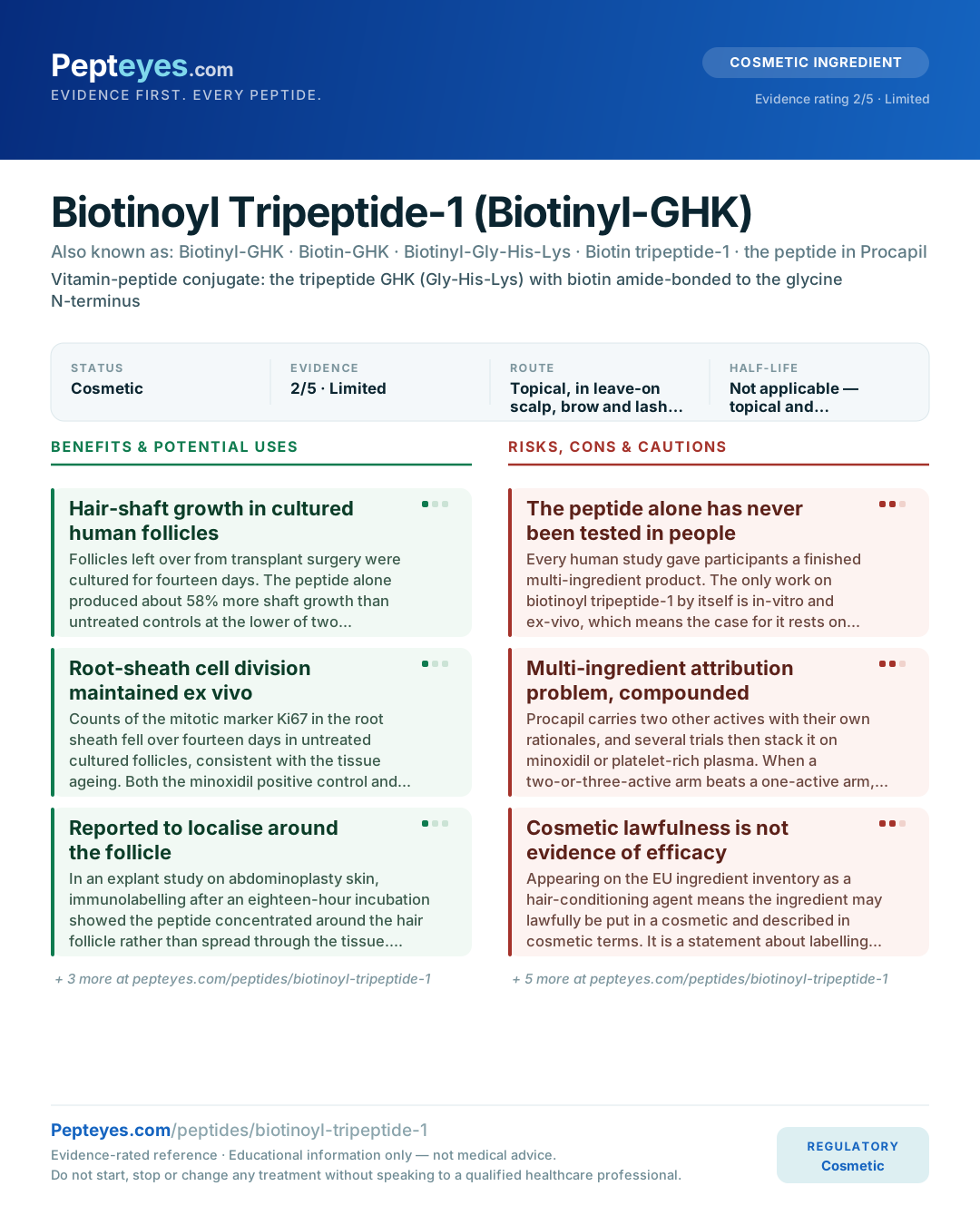
Benefits — Biotinoyl Tripeptide-1 (Biotinyl-GHK)
- Hair-shaft growth in cultured human follicles
Follicles left over from transplant surgery were cultured for fourteen days. The peptide alone produced about 58% more shaft growth than untreated controls at the lower of two concentrations, similar to the minoxidil positive control, and about 121% more at the higher one. This is human tissue in a dish, not a person.
- Root-sheath cell division maintained ex vivo
Counts of the mitotic marker Ki67 in the root sheath fell over fourteen days in untreated cultured follicles, consistent with the tissue ageing. Both the minoxidil positive control and the peptide kept the count up. A laboratory readout on explanted tissue, with no clinical endpoint attached.
- Reported to localise around the follicle
In an explant study on abdominoplasty skin, immunolabelling after an eighteen-hour incubation showed the peptide concentrated around the hair follicle rather than spread through the tissue. That addresses the obvious objection to a hydrophilic tripeptide, but it is a short explant experiment from the manufacturer's own dossier.
- Anagen shift in a blend trial
A four-month randomised placebo-controlled trial in 35 men, 18 on the blend and 17 on an indistinguishable placebo, measured the anagen-to-telogen ratio by videotrichogram and reported roughly a tenth more hair in the growth phase than at baseline, with no change on placebo. It tested the three-ingredient lotion, so nothing in it is attributable to the peptide.
- Possible add-on value to minoxidil or PRP
A randomised trial in 140 men alternating the blend with 5% minoxidil reported higher hair counts than 5% minoxidil alone over twelve months, and a 160-patient non-randomised study favoured platelet-rich plasma plus the blend over PRP alone. A third randomised trial, in 54 men, found the blend plus PRP did worse than a rival multi-ingredient topical plus PRP. None isolates the peptide.
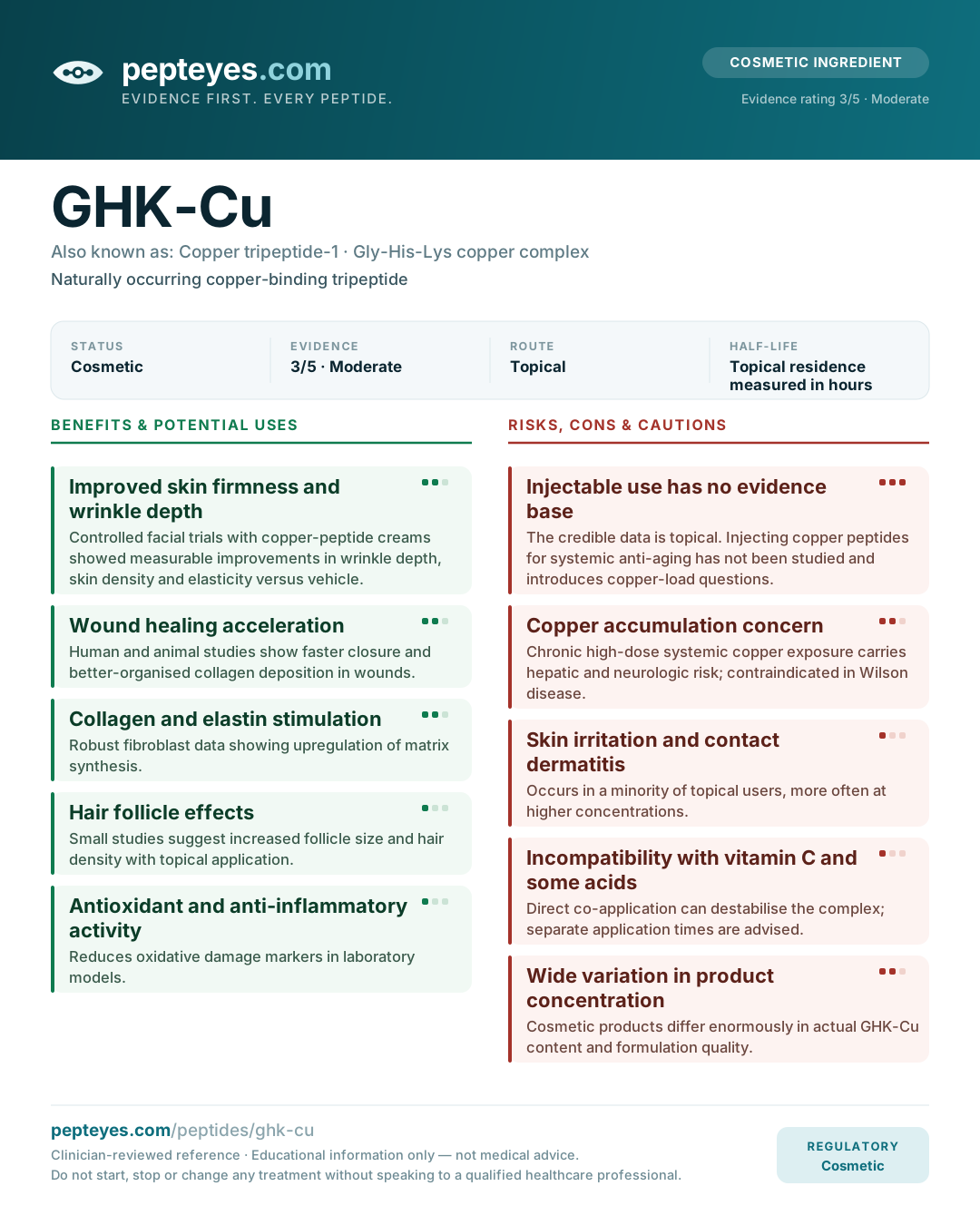
Benefits — GHK-Cu
- Improved skin firmness and wrinkle depth
Small facial studies reported modest improvements in wrinkle depth, skin density and elasticity against comparison creams. The best, a randomised 8-week split-face trial, was maker-funded and could not separate GHK-Cu from its carrier; the older cream studies exist only as conference abstracts.
- Wound healing acceleration
A randomised, blinded trial found faster closure of diabetic foot ulcers, but the maker's larger 511-patient trial failed. Animal wound studies consistently show faster closure and better-organised collagen.
- Collagen and elastin stimulation
Robust fibroblast data showing upregulation of matrix synthesis.
- Hair follicle effects
Cell and animal work shows effects on hair-follicle cells. No controlled trial of GHK-Cu alone has tested scalp hair loss; the human trial usually cited used a copper-free GHK compound.
- Antioxidant and anti-inflammatory activity
Reduces oxidative damage markers in laboratory models.
Risks & cons — Biotinoyl Tripeptide-1 (Biotinyl-GHK)
- The peptide alone has never been tested in people
Every human study gave participants a finished multi-ingredient product. The only work on biotinoyl tripeptide-1 by itself is in-vitro and ex-vivo, which means the case for it rests on follicles in a culture dish rather than on anyone's scalp.
- Multi-ingredient attribution problem, compounded
Procapil carries two other actives with their own rationales, and several trials then stack it on minoxidil or platelet-rich plasma. When a two-or-three-active arm beats a one-active arm, the extra effect could belong to any component or to none of them individually.
- Cosmetic lawfulness is not evidence of efficacy
Appearing on the EU ingredient inventory as a hair-conditioning agent means the ingredient may lawfully be put in a cosmetic and described in cosmetic terms. It is a statement about labelling and safety review, not a regulator's conclusion that it does anything to hair loss.
- The peptide-specific data comes from the ingredient manufacturer
The follicle-explant growth study, the localisation study and the gene array were commissioned by the company that makes the blend and circulate as a technical dossier rather than as peer-reviewed papers. They have not been independently replicated.
- Biotin on a peptide is not a biotin supplement
The biotin here is chemically bonded to a tripeptide and applied to the scalp. It is not a nutrient being delivered, and it says nothing about swallowing biotin, which in reviewed case reports helped only people with a genuine deficiency or a specific hair or nail disorder.
Risks & cons — GHK-Cu
- Injectable use has no evidence base
The credible data is topical. Injecting copper peptides for systemic anti-aging has not been studied and introduces copper-load questions.
- Copper accumulation concern
Chronic high-dose systemic copper exposure carries hepatic and neurologic risk; contraindicated in Wilson disease.
- Skin irritation and contact dermatitis
Occurs in a minority of topical users, more often at higher concentrations.
- Incompatibility with vitamin C and some acids
Direct co-application can destabilise the complex; separate application times are advised.
- Wide variation in product concentration
Cosmetic products differ enormously in actual GHK-Cu content and formulation quality.
A comparison is not a recommendation. Neither column is being suggested for you. Which — if either — is appropriate depends on your diagnosis, history and medications, and that is a conversation for a qualified clinician.